An Epitaph: To those who bloomed where they were not meant to grow

I stumbled on a new word last week. Lobotomy. It was used as both a noun and a verb. A lobotomy. To be lobotomised. I had to look it up. And what I found felt like an incomplete epitaph, of lives that were never given the chance to be fully inhabited.

In the 1940s and 1950s, a physician named Walter Freeman drove across America in a van he called the “lobotomobile,” performing ice pick lobotomies. It is a procedure in which a metal spike was hammered through the eye socket and into the frontal lobe of thousands of patients. These people were “treated” for depression, for anxiety, for schizophrenia. Others were committed for being difficult. For being inconvenient. And some were subjected to it as a cure for homosexuality.

My horror felt close, nothing like the unsettling but safely distant stance we take toward practices we have long since condemned to history. No. This did not feel distant at all. It felt coldly present, that we are in fact still doing this. Not with metal spikes. Not in hospitals. But it is alive and thriving, the social project of flattening human beings into acceptable and untroubling shapes.

This essay is my attempt to re-write that epitaph and to insist that what was buried was not dead, only forced underground.

It made me think of every LGBTQIA+ person who has been subjected to conversion therapy, not the crude electroshock versions that make for harrowing documentaries, but the quieter, longer, more insidious kind. The kind administered by a parent’s silence, a pastor’s weekly sermon, a community’s cold disapproval. The kind that doesn’t announce itself as therapy at all, but functions as one long, relentless message: who you are is wrong. Make it stop. Make yourself stop. The self goes underground. The feelings get managed away. A kind of living diminishment settles in.

It made me think about the artists, the thinkers, the visionaries who never became who they might have been. The writers who burned their manuscripts. The musicians who chose silence. The leaders whose courage was disciplined out of them before it could fully form. We will never know what we lost. That is perhaps most devastating. The art unmade, the ideas unthought, the movements that never began because the people who would have led them were too busy surviving. Not living.

The lobotomy procedures of the ironically named Freeman were considered successful. The patient’s anguish was declared resolved. Gone. So was almost everything else: the creativity, the desire, the depth of feeling, the spark that makes a person recognizably themselves. Patients became docile. Manageable. Empty. Families sometimes described them as shadows. Present in body, absent in soul.

During my second year in high school, South Africa’s public school education system started undergoing changes that included cut-backs on subsidies. My class group was selecting our core subjects for the following year, many of us enthused to pursue music, drama, art, as preludes to colourful careers we were conjuring. This was not to be. 

The school I attended decided to mainstream STEM – science, technology, economics, mathematics – touted as the profitable, sensible, and most efficient career paths to follow. Arts teachers were made redundant, music practice rooms became storage spaces, easels were flung from windows with a haste that could not pause to consider donating them, repurposing them, or even setting them gently down. They were burned. 

I was able to take a transfer to another public school, much further away, that managed to spare its speech and drama programme that I happily signed up for. But many of my previous classmates, too many, were forced to dull themselves into conformity. I still think of their talent, what brilliance, what innovative leadership we lost in the burning of those easels.

While this took place at the precipice of South Africa’s end to institutional apartheid, the ice picks of political lobotomy had long been hammered into the decision makers of our time. It maimed and dulled their creative thinking. 

Frantz Fanon clearly articulated this, well ahead of his time, as he examined what colonialism does to the interior life of the colonized. He wrote about the psychic damage of being forced into an identity not your own, of having your culture, language, and selfhood treated as pathological. He was writing about the colonial lobotomy long before anyone used that metaphor. 

Pathology is indeed quite apt here, not just rhetorically but analytically. A pathology is not merely a bad occurrence. It is a system that has turned against its own host. The immune system attacking the body. The very mechanisms meant to ensure survival becoming the source of destruction.

A society that suppresses its most alive, most generative, most imaginative elements – its queers, its artists, its dissenters, its dreamers – is not protecting itself. It is consuming itself. The conformity that feels like safety is actually a slow diminishment of the collective capacity to adapt, to create, to feel, to survive with any genuine depth. And it is self-reinforcing. The more emotional bluntness a society produces, the less equipped its members are to recognize what has been lost. 

You cannot mourn a feeling you have been prevented from having. You cannot defend an inner life you were never permitted to develop. The lobotomized patient does not grieve their own creativity. That is precisely what was taken.

This is why the sociology of deviance was most fascinating to me during my postgraduate studies. I started to understand, and appreciate, that the “deviant” –  the homosexual, the bohemian artist, the radical thinker – represents a relationship to desire and interiority that cannot be fully regulated from outside. You cannot legislate what someone truly wants. You cannot audit the inside of an imagination. 

Both the queer person and the artist are, in a fundamental sense, answerable to an inner authority. It is our desire, vision, feeling that resists external override. That is what makes us dangerous. It is not the content of what we do so much as the fact that we are oriented inward, toward what the state or institutional religion or the community cannot own or direct. We have, in the deepest sense, a source of authority that competes with the official one.
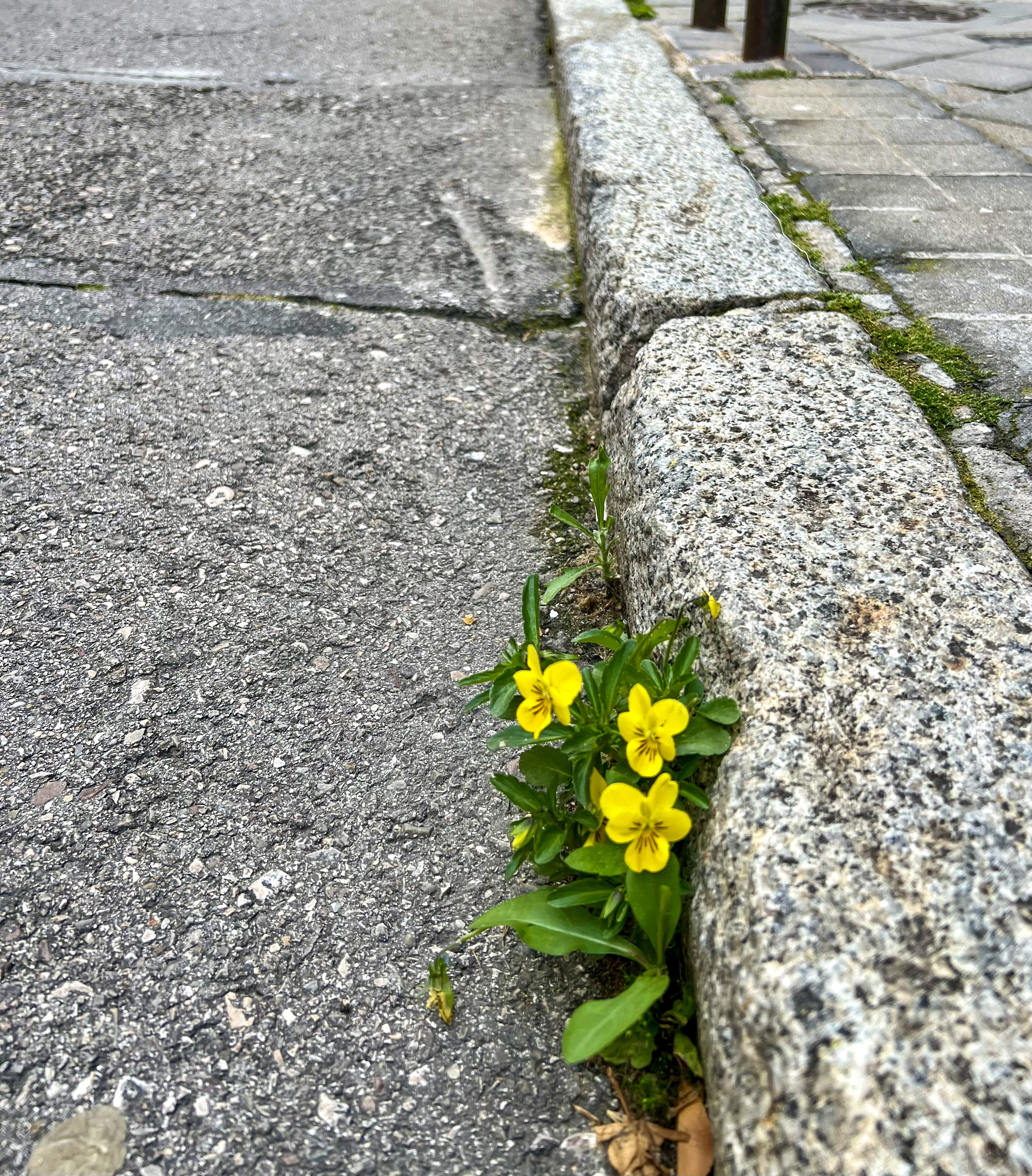
What was buried but never destroyed: Pansies blossoming from a concrete sidewalk. Madrid. 2026. 

And yet. There are those who refused to be managed, who bloomed where they were not meant to grow. Gloria Anzaldúa helps us understand what it means to live beyond the cultural, sexual, and psychological borders that others have tried to enforce. Her work Borderlands/La Frontera makes the case that the suppression of fluid identity and the suppression of a creative or spiritual life are the same violence. For her, writing itself was an act of bodily and political survival. Audre Lorde makes the same argument from a different wound: the deep, embodied capacity for feeling and joy is systematically suppressed in women and in oppressed people for exactly this reason. It is a source of genuine power and self-knowledge that no external force can confiscate.

We rightly condemn Walter Freeman. And we should. But let us be honest about why he was able to do what he did, for as long as he did, to as many people as he did. He operated in a culture that was profoundly uncomfortable with human complexity, with grief that didn’t resolve, with desire that didn’t conform, with minds that worked differently. The lobotomy was a solution the culture was waiting for. It answered a question the culture was already asking: how do we make the difficult ones easier to live with?

We are still asking it. We are still answering it. The honest epitaph we owe to the people of those 1940s operating tables is a commitment to stop doing the same procedure with different tools. It is a demand that we build a world capacious enough for the full range of what it means to be human, where passion is not pathologized, where difference is not punished, and the interior life is not a problem to be managed.

The tragedy of the lobotomy was in what was presumed: that a quieter person is a better one. That a life stripped of joy and fire and depth, is preferable to a difficult, luminous, fully-inhabited one.

We have not yet stopped presuming that. And until we do, dare we even claim the right to call ourselves civilized?

Written by Merlin Ince

The Fascists Do Like Their Walls, Don’t They

When a government refuses to confront inequality, it builds a wall. It is easier than justice, faster than reform, and far less uncomfortable than asking why crime exists in the first place. The City of Cape Town’s proposed ZAR180 million wall along the N2 is being sold as a safety measure. In reality, it is a design choice rooted in fear, optics, and a long tradition of pretending that poverty disappears when it is hidden from sight.

Table Mountain stands close enough to see, and far enough to deny an entire generation access to the city beneath it.

This kind of decision never exists in a racial vacuum. In South Africa, walls do not simply divide space. They divide bodies, histories, and assumptions. The communities being screened off along the N2 are overwhelmingly poor and overwhelmingly Black. The message is intentionally wrapped in the neutral language of “risk mitigation” and “public safety” but it is nonetheless blunt: danger lives there, and safety belongs here. Crime is racialised by geography, and poverty becomes a visual contaminant to be managed rather than an injustice to be addressed.

This is where the wall goes beyond being offensive, and starts becoming familiar. Fascist movements have always understood that separation does half the ideological work for you. You do not need to convince people that others are dangerous if you can simply place a barrier between them. Walls externalise fear, harden prejudice, and erase context. They turn political failure into architecture and call it order.

The City insists that the wall will stop stoning incidents and criminal attacks on vehicles entering Cape Town. This is security theatre dressed up as urban planning. It assumes crime is static, unimaginative, and spatially obedient. It ignores the rather well-documented reality that criminals tend to go around, over, under, or through obstacles placed in their way. Sometimes they bribe. Sometimes they adapt. Sometimes they operate from the “safe” side of the wall entirely.

A wall does not dismantle criminal networks. It does not interrupt supply chains. It does not address motive, opportunity, or organisation. It simply moves the problem out of sight, which is, of course, the point.

This brings us to the most corrosive lie underpinning this project, that low-income communities produce criminals. More than being just wrong, it is also lazy, dangerous, and morally bankrupt. We do not know who these criminals are. We do not know where they come from, how they operate, or who benefits from their actions. Crime in South Africa is not a spontaneous chemical reaction triggered by poverty. It is structured, organised, and often profitable. To collapse this complexity into a moral judgement about low-income communities is quite simply scapegoating. Worse still, it blames people who are themselves the most exposed to violence.

The communities along the N2 are saturated by crime. They live without the buffers that wealth provides. They do not have private security patrols, high walls topped with electric fencing, nor rapid-response panic buttons. When crime happens there it does not become a headline because it is a condition of daily life. And yet somehow, such communities are framed as the threat rather than the threatened.

This is where the City of Cape Town’s moral priorities become impossible to ignore.

The urgency around this wall did not emerge because residents of these communities are unsafe. It emerged because tourists are. The crisis is not violence itself, but violence that interrupts the airport corridor, the welcome mat, the first impression. When locals suffer, the city shrugs and cites complexity. When visitors feel uneasy, budgets are magically unlocked and the concrete mixers roll in.

Tourist safety is treated as an economic imperative. Local safety is treated as an unfortunate complication. And so, we arrive at the real function of the wall. It is not about protection. It is about erasure.

The wall is meant to stop visibility, to hide poverty from passing eyes, to preserve the illusion of a “world-class city” untroubled by the realities that sustain it. This impulse, to sanitise space, to prioritise aesthetics over justice, to bulldoze truth in the name of development, has become a defining feature of Cape Town’s governance.

We have seen it in the city’s hostility to the Save Our Sacred Lands campaign. We have seen it in the Two Rivers Urban Park development, where community heritage voices about sacred spaces were treated as obstacles rather than stakeholders. Again and again, the same pattern emerges. Dissent is inconvenient, poverty is embarrassing, and development must proceed, even if it requires erasure.

This is neoliberalism flirting openly with authoritarian instincts. It is fascism without the theatre, exclusion without the rhetoric. It is clean, efficient, and devastatingly polite.

The obscenity of this project is sharpened further when one follows the money. ZAR180 million is being marshalled for concrete, steel, and the maintenance of denial. We are told, endlessly, that meaningful solutions to crime are too complex, too expensive, too difficult to implement.

This is simply not true. The truth is far more uncomfortable. Walls are chosen because better solutions would require the city to see people living in poverty as worthy of safety even when no tourist is watching. That refusal, to recognise dignity without an audience, is expressed in budgets, in planning decisions, and in what the city repeatedly chooses not to fund. And it is precisely here that the wall collapses as a solution and reveals itself as a choice.

The same funds earmarked for a wall could be used to strengthen community capacity, organisation, and agency. These are the elements that actually produce safety over time. Community-based safety workers, mediators, and first responders drawn from local neighbourhoods are sustainable solutions to crime and violence. Their effectiveness lies in presence, relationships, and accountability because they are forms of safety that cannot be outsourced or poured in concrete. Within a ZAR180 million budget, the city could sustain hundreds of such roles over several years, embedding safety within communities rather than imposing it from the outside.

Investment in youth employment and skills development sits within the same logic. Cities that have meaningfully reduced violence have done so by expanding people’s stake in their communities and their futures. Medellín[1] is particularly instructive because it reorganised power and possibility. By investing in education, mobility, public space, and local enterprise in historically marginalised areas, the city enabled young people to participate as producers of the city. Safety emerged through inclusion, opportunity, and shared ownership of place.

Culture played a central role in this process. Music, visual arts, dance, theatre, and community media were engines of mobilisation and cohesion. Cultural programmes created spaces where identity could be expressed, solidarity built, and public areas reclaimed. Youth orchestras, hip-hop schools, arts centres, and neighbourhood festivals strengthened social ties and made communities visible on their own terms. These initiatives displaced violence by filling public space with meaning, activity, and collective presence.

The same principle underpinned Glasgow’s[2] shift toward treating violence as a public issue rather than a moral defect. Community-led interventions, long-term investment in people, and a recognition of shared responsibility reshaped how safety was produced and sustained. In both cases the lesson is direct, which is that communities become safer when they are empowered to organise, care for one another, and shape the environments they live in.

Strengthening trauma-informed health services, substance-use support, and victim assistance fits squarely within this framework. Violence fractures social bonds. Repairing those fractures is part of rebuilding safety. Care, culture, and opportunity are therefore the foundation of community safety and security. 

These are tested approaches to safety that are grounded in community agency, shared ownership, and sustained public investment. The question for Cape Town is why they are so readily dismissed in favour of concrete and concealment.

Safety and wellbeing is produced when communities are resourced to organise, to care for one another, and to shape the spaces they inhabit. This is slower work than pouring a wall, but it is also the only work that lasts.

Written by Merlin Ince


[1] Story of Change: The Medellín Miracle

[2] Glasgow’s Community Initiative to Reduce Violence