Homeless and hopeful

IMG_0875

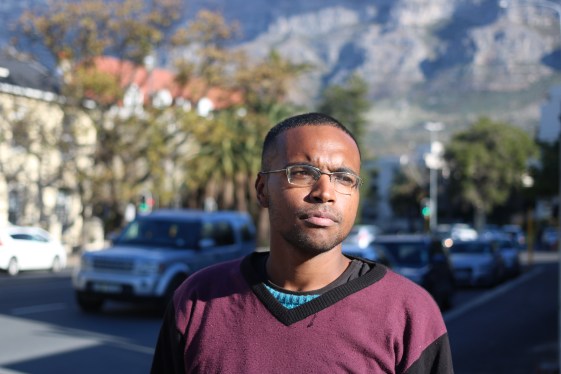
Ameer makes a living from collecting cardboard and metal cans for recycling

It is very easy to ignore a homeless person. The idea of not having a secure place to live or a weathered appearance conveys a sense of anonymity. Their identity becomes opaque and distant from the mainstream traffic of cities, hastily rushing to work or back home. For those who have neither of these, they struggle to find recognition.  Living on the streets is a marginal existence but there are still stories of dignity behind every face of such hardship.

The City of Cape Town’s mayoral committee for social development has found that there are more than 7 000 homeless people in the municipality. Ameer is one such person. He came to Cape Town from Bloemfontein on a pretentious job offer, expecting to work as a van assistant on overnight truck hauls, with the promise of advancing his interest in motor mechanics. Instead, he was told to guard trucks owned by a businessman who was not prepared to pay the expensive fees of truck stations. Ameer was not remunerated, he was mistreated, and left to fend for himself. With no family or other support network in Cape Town, he took to the hostile streets of the city to make a living.

On any given morning, Ameer can be found outside the Woolworths on Kloof Street where he has an arrangement with the store manager to collect the cardboard from delivery trucks. He also collects empty metal cans which he crushes into flat disks, all for recycling. It is a harrowing mission to transport these waste materials on a makeshift cart about 3km from the CBD to Woodstock, competing with the morning traffic that impatiently hoots at him for getting in their way. This same traffic hurries off to produce more waste that Ameer finds a purpose for. He sells the cardboard for about 70c per kg and the cans for R10 per kg. He makes just about enough to buy some food for the day.

The Centre for Food Security at the University of the Western Cape has found that individuals like Ameer, across the country, save municipalities R 700 000 per year by keeping recyclable material from exhausting landfill sites. But despite the dignity and purpose that Ameer manages to find from wastepicking, he still faces indignation.

Security personnel in the city consider Ameer as a criminal. He is often rudely awakened from the meagre shelter of an alleyway or bus stop by a group of security guards. They have used pepper spray and batons on occasion to wake him up and chase him away: “They think I am going to break into the cars and steal something,” he says. “I just avoid them. I can’t even sit anywhere I want. They watch me like I am going to steal something. That is what I wish for more than anything else, just to be able to walk and sit anywhere. But that creates trouble for me so I just avoid them.”

Thankfully Ameer has been able to experience a kinder face of the city through a clinic in Greenpoint. Even though he is not an outpatient, the facility still provides support for him. Ameer is able to speak with a counsellor, take a shower, and have a meal twice a week. His face lights up and softens when he speaks about the care he receives, like it is an oasis of hope in the midst of a harshly marginal existence out on the streets of Cape Town.

Hope is what Ameer holds on to most firmly, resolving himself not to give in to the tragedy of what brought him to this space: “I do my best everyday with whatever I can get. I still want to go back home to my grandmother in Bloemfontein.” Ameer has been trying to save money to afford transport back home to be reunited with his grandmother, younger brother, and sister. He also has dreams of pursuing a career when he has settled himself again: “I always wanted to work with cars, like a motor mechanic, even to one day own my own workshop, I would be so happy for that.”

Holding hope and adversity is hard to do. Those who live on the margins must bear the strain of this arduous identity everyday, tragically muted by the traffic of mainstream city life, chasing capital. This counterpoint of city life is highlighted by artists such as Brazilian writer Jorge Amado. In the introduction to his novel Captains of the Sands,  Colm Tóibín points out that Amado unearths the dignity of abandoned children on the streets of Bahia in Salvador but the book does not romanticize their story, “it is written to give substance to shadows, to re-create the under-life of the city, to offer the dispossessed an inner life.”

Stories of people like Ameer can help us bring light into peripheral shadows in order for us to re-create cities as more inclusive and respectful spaces. But only if we slow the traffic down, stop, and listen.
Written by Merlin Ince

The Shadowed Face of Community Activism

Merlin_43

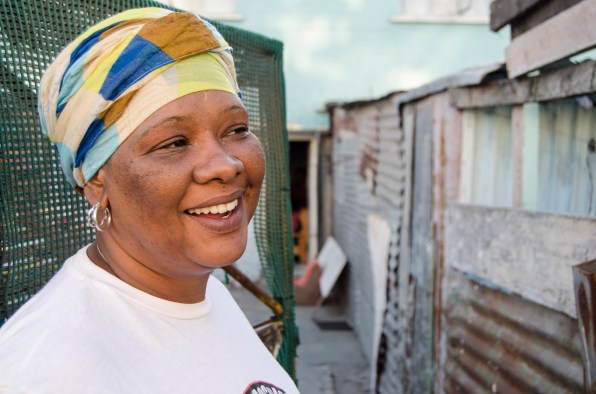
Community Activist Roegshanda Pascoe outside her home in Manenberg, Cape Town

I first met Roegshanda Pascoe at a Community Safety Forum meeting in Manenberg, Cape Town. It was on an evening in March 2016 when the local authority scheduled an electricity blackout as a load shedding initiative during a time of uncertainty about the country’s energy supply capacity. Roegshanda was lighting a row of candles as I entered the church hall, where residents were gathering to discuss their concerns over the housing crisis and inadequate policing during gang wars.

As a silhouetted figure, against the candlelight behind her, Roegshanda bravely held that volatile space together. Tempers flared and raged, and understandably so! Since the neighbourhood’s inception, as an apartheid ghetto almost five decades ago, little has been done to raise the standard of living for residents here.

When I visited Roegshanda at her home in Manenberg, she explained that housing bylaws have not changed since the dismantling of apartheid legislation. Old rules and systems of allocation still apply, even though they are irrelevant. It is not possible for residents to have private ownership of their units in the three-storey blocks, called Courts. The water meters are not constructed for individual units but for entire blocks. The sewage infrastructure is such that it is all connected to a central system so if there is a blockage about five roads away, then the entire area is affected.

The overcrowding in most homes fuels anger and frustration since there is a competition for space and privacy: “It is everybody stepping on each other’s toes and so there is no space in your house… If there is a Janaza (Islamic funeral), there is not even enough space to bring a body into the house properly for the funeral rituals. It has to be turned this way and that way. No dignity in that.” She believes that the solution is to demolish the Courts in phases and rebuild structures that are more conducive to a better quality of life. People will then get a chance to own their homes, gaining a sense of dignity and purpose.

It is a largely held view that Manenberg’s social demise is due to overcrowding. A resident at the community meeting raised this concern, to strong approval from the gathering, that the neighbourhood was established almost fifty years ago to accommodate 35 000 people but this number has steadily grown to more than 100 000 residents. Roegshanda believes that census figures, which record Manenberg’s population at 58,875, are deliberately tampered with to sidestep the crisis of overpopulation and the responsibility that the local authority would have in order to remedy the situation: “if the full amount of people living in Manenberg would come out, don’t you think everybody would scream My God this place needs a facelift…I took the city officials around to see what is happening in Thames Avenue and they said to me My God can people live like this? Are these humans staying here? And I said Ha! Are you asking me that? Then you must tell your bosses that humans have to live like animals here.

Currently, units are rented on a two-year basis and then renewed afterwards. If heads of households die, there is no assurance that the children will be able to continue living there. Evictions are often carried out in the area and people are stranded with no other place to go. Roegshanda works tirelessly to get lawyers who can defend residents in court. The authorities responsible for evictions are dubbed ‘the red ants’. They arrive on the allocated day, remove all possessions from the house and then lock the premises while families possessions are left on the pavement with their possessions.

Community activism, that attempts to highlight the plight of marginalised and maligned ghettos of Cape Town, is both ignored and misunderstood. Radio stations only highlight protest activity in traffic reports, as though they are another inconvenience to be avoided en route elsewhere. News agendas seldom ever probe the reasons behind protests or take the time to investigate the causes that are being bravely fought for.

Post-apartheid South Africa has been characterised by an increase in community protests, especially since 2004. Wasserman et al (2018) poignantly remind us that this is not merely about service delivery failures but should be seen as “an expression of a wider and more long-standing disenchantment in marginalised communities.” The very act of defiance through protest speaks volumes about the inability and failure of mechanisms such as the media to give voice to a large majority of our country’s poor: “Although service delivery has become the rallying point for protests, it should also be seen as a manifestation of a deeper disillusionment with post-apartheid democracy.”

Community activists are often the only figures of hope in poverty-stricken neighbourhoods. They are largely the most trusted and relied upon individuals since there is a deep-seated mistrust among residents for police and local authority officials. They are close to the heart of people’s struggles and understand the daily complexities that are all too casually brushed over by local government structures who would rather dictate what should be done instead of listening to the real issues at stake.

In the neighbourhood of Hanover Park, another relic of apartheid segregation, a recreational park known as Phillans Park was identified as a priority project by the local authority for an upgrade. Without consulting with residents, workers started construction but within a few days they had to abandon the project due to gang violence. The park has always been a ‘red zone’ since it is an area between two rival gangs. Gangsters therefore shoot randomly across this field, where a government saw it fit to encourage children to play in an upgraded and lavish recreation facility. How utterly useless!

The  presence of gangs, and the high-risk activity they engage in, are not only a threat to the safety of innocent lives in the neighbourhood. Anyone who challenges them does so at great risk to their personal safety. The structure of gangs is such that they do not want to be interfered with by external initiatives of social development that might usurp the power that they wield in communities like Manenberg. They hold these neighbourhoods captive and terrorise residents through wild shooting sprees in their battle for turf with rival gangs. Activists who speak out against them are targeted and threatened. Roegshanda has, on numerous occasions, put up social media posts about being threatened with her own life. Still, she remains resilient.

Despite the heroic efforts of community activists, they face a daily uphill battle to organise communities into action. With meagre support networks and resources, they draw on whatever means they have available to them in order to raise the voices of people who have known little freedom and transformation, more than two decades after the end of apartheid. The efforts of community activists like Roegshanda Pascoe are a heroic struggle for justice and equality, shadowed by the financial greed of neoliberal leaders who have turned their backs on the poor.

Written by Merlin Ince
Reference: Wasserman H, Bosch T and Chuma W (2018) ‘Communication from above and below: Media, Protest and Democracy’. Politikon South African Journal of Political Studies
Photograph Credit: Lu Nteya