An Epitaph: To those who bloomed where they were not meant to grow

I stumbled on a new word last week. Lobotomy. It was used as both a noun and a verb. A lobotomy. To be lobotomised. I had to look it up. And what I found felt like an incomplete epitaph, of lives that were never given the chance to be fully inhabited.

In the 1940s and 1950s, a physician named Walter Freeman drove across America in a van he called the “lobotomobile,” performing ice pick lobotomies. It is a procedure in which a metal spike was hammered through the eye socket and into the frontal lobe of thousands of patients. These people were “treated” for depression, for anxiety, for schizophrenia. Others were committed for being difficult. For being inconvenient. And some were subjected to it as a cure for homosexuality.

My horror felt close, nothing like the unsettling but safely distant stance we take toward practices we have long since condemned to history. No. This did not feel distant at all. It felt coldly present, that we are in fact still doing this. Not with metal spikes. Not in hospitals. But it is alive and thriving, the social project of flattening human beings into acceptable and untroubling shapes.

This essay is my attempt to re-write that epitaph and to insist that what was buried was not dead, only forced underground.

It made me think of every LGBTQIA+ person who has been subjected to conversion therapy, not the crude electroshock versions that make for harrowing documentaries, but the quieter, longer, more insidious kind. The kind administered by a parent’s silence, a pastor’s weekly sermon, a community’s cold disapproval. The kind that doesn’t announce itself as therapy at all, but functions as one long, relentless message: who you are is wrong. Make it stop. Make yourself stop. The self goes underground. The feelings get managed away. A kind of living diminishment settles in.

It made me think about the artists, the thinkers, the visionaries who never became who they might have been. The writers who burned their manuscripts. The musicians who chose silence. The leaders whose courage was disciplined out of them before it could fully form. We will never know what we lost. That is perhaps most devastating. The art unmade, the ideas unthought, the movements that never began because the people who would have led them were too busy surviving. Not living.

The lobotomy procedures of the ironically named Freeman were considered successful. The patient’s anguish was declared resolved. Gone. So was almost everything else: the creativity, the desire, the depth of feeling, the spark that makes a person recognizably themselves. Patients became docile. Manageable. Empty. Families sometimes described them as shadows. Present in body, absent in soul.

During my second year in high school, South Africa’s public school education system started undergoing changes that included cut-backs on subsidies. My class group was selecting our core subjects for the following year, many of us enthused to pursue music, drama, art, as preludes to colourful careers we were conjuring. This was not to be. 

The school I attended decided to mainstream STEM – science, technology, economics, mathematics – touted as the profitable, sensible, and most efficient career paths to follow. Arts teachers were made redundant, music practice rooms became storage spaces, easels were flung from windows with a haste that could not pause to consider donating them, repurposing them, or even setting them gently down. They were burned. 

I was able to take a transfer to another public school, much further away, that managed to spare its speech and drama programme that I happily signed up for. But many of my previous classmates, too many, were forced to dull themselves into conformity. I still think of their talent, what brilliance, what innovative leadership we lost in the burning of those easels.

While this took place at the precipice of South Africa’s end to institutional apartheid, the ice picks of political lobotomy had long been hammered into the decision makers of our time. It maimed and dulled their creative thinking. 

Frantz Fanon clearly articulated this, well ahead of his time, as he examined what colonialism does to the interior life of the colonized. He wrote about the psychic damage of being forced into an identity not your own, of having your culture, language, and selfhood treated as pathological. He was writing about the colonial lobotomy long before anyone used that metaphor. 

Pathology is indeed quite apt here, not just rhetorically but analytically. A pathology is not merely a bad occurrence. It is a system that has turned against its own host. The immune system attacking the body. The very mechanisms meant to ensure survival becoming the source of destruction.

A society that suppresses its most alive, most generative, most imaginative elements – its queers, its artists, its dissenters, its dreamers – is not protecting itself. It is consuming itself. The conformity that feels like safety is actually a slow diminishment of the collective capacity to adapt, to create, to feel, to survive with any genuine depth. And it is self-reinforcing. The more emotional bluntness a society produces, the less equipped its members are to recognize what has been lost. 

You cannot mourn a feeling you have been prevented from having. You cannot defend an inner life you were never permitted to develop. The lobotomized patient does not grieve their own creativity. That is precisely what was taken.

This is why the sociology of deviance was most fascinating to me during my postgraduate studies. I started to understand, and appreciate, that the “deviant” –  the homosexual, the bohemian artist, the radical thinker – represents a relationship to desire and interiority that cannot be fully regulated from outside. You cannot legislate what someone truly wants. You cannot audit the inside of an imagination. 

Both the queer person and the artist are, in a fundamental sense, answerable to an inner authority. It is our desire, vision, feeling that resists external override. That is what makes us dangerous. It is not the content of what we do so much as the fact that we are oriented inward, toward what the state or institutional religion or the community cannot own or direct. We have, in the deepest sense, a source of authority that competes with the official one.
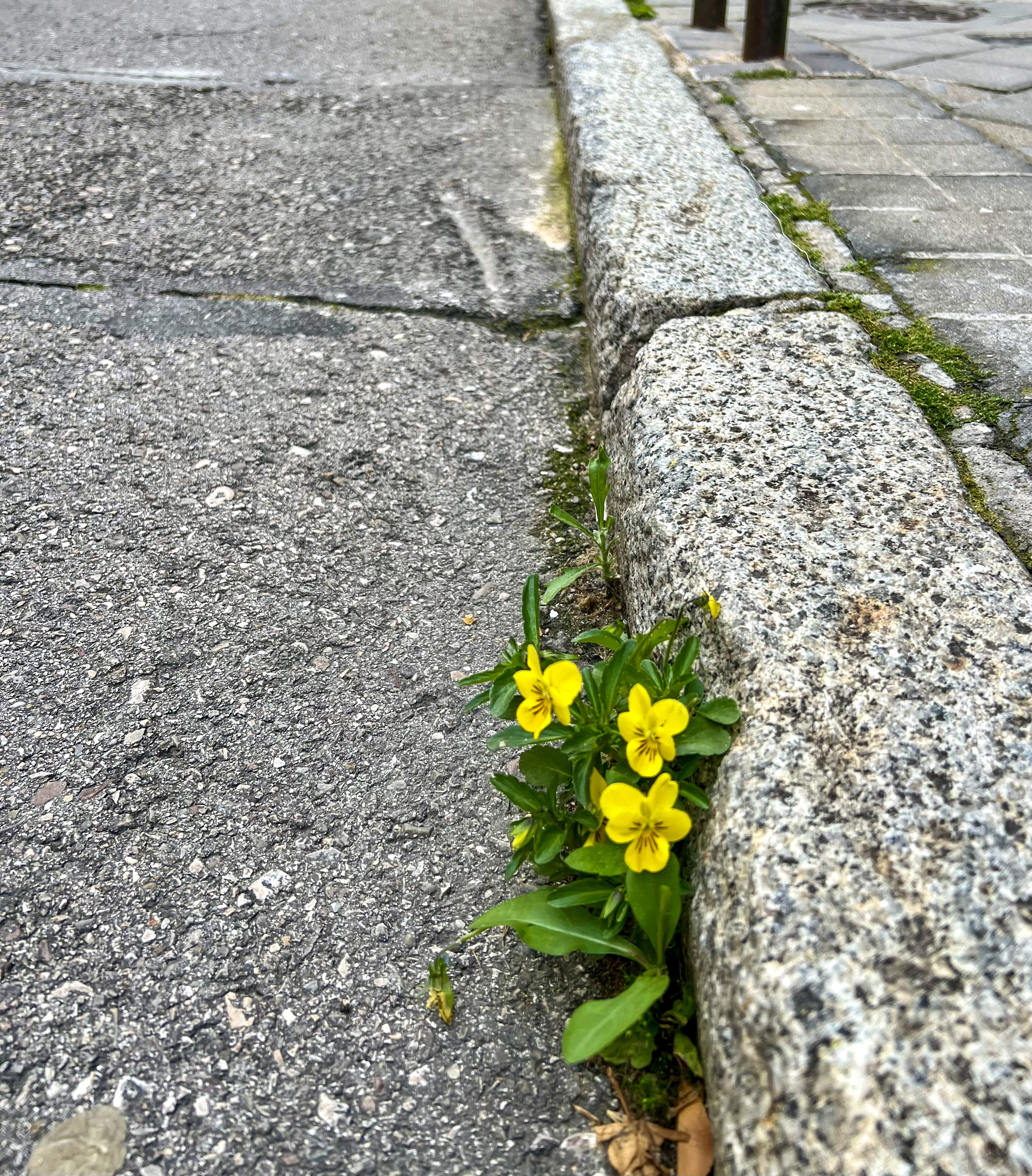
What was buried but never destroyed: Pansies blossoming from a concrete sidewalk. Madrid. 2026. 

And yet. There are those who refused to be managed, who bloomed where they were not meant to grow. Gloria Anzaldúa helps us understand what it means to live beyond the cultural, sexual, and psychological borders that others have tried to enforce. Her work Borderlands/La Frontera makes the case that the suppression of fluid identity and the suppression of a creative or spiritual life are the same violence. For her, writing itself was an act of bodily and political survival. Audre Lorde makes the same argument from a different wound: the deep, embodied capacity for feeling and joy is systematically suppressed in women and in oppressed people for exactly this reason. It is a source of genuine power and self-knowledge that no external force can confiscate.

We rightly condemn Walter Freeman. And we should. But let us be honest about why he was able to do what he did, for as long as he did, to as many people as he did. He operated in a culture that was profoundly uncomfortable with human complexity, with grief that didn’t resolve, with desire that didn’t conform, with minds that worked differently. The lobotomy was a solution the culture was waiting for. It answered a question the culture was already asking: how do we make the difficult ones easier to live with?

We are still asking it. We are still answering it. The honest epitaph we owe to the people of those 1940s operating tables is a commitment to stop doing the same procedure with different tools. It is a demand that we build a world capacious enough for the full range of what it means to be human, where passion is not pathologized, where difference is not punished, and the interior life is not a problem to be managed.

The tragedy of the lobotomy was in what was presumed: that a quieter person is a better one. That a life stripped of joy and fire and depth, is preferable to a difficult, luminous, fully-inhabited one.

We have not yet stopped presuming that. And until we do, dare we even claim the right to call ourselves civilized?

Written by Merlin Ince
When the bullies came: Navigating trauma as LGBTQIA+

In 1990, homosexuality was officially removed from The International Classification of Diseases as a psychological disorder. According to Code F66.0, an adolescent could be diagnosed as depressed or anxious over “an immature state of sexual development” which gives rise to conflicting or confusing sexual desires(1). As such, homosexuality, was considered an illness that needed treatment and remedying. It was a condition that needed to be put right, because it was thought to be wrong. In 1990 I was 15 years old.

Much of my childhood and adolescence happened in a world that considered me to be sick. Being gay was a sickness and like many ‘illnesses’ that we are misinformed about, it was highly stigmatized. People feared me and stood apart from me. School was especially brutal. Having other kids taunt me with hateful names was one part of the routine I had to brace myself for each morning as I tied my shoe laces and loaded my bag on my shoulders, gulping down the lump in my throat as I walked through the school gates. The other part was having teachers instigate and condone the bullying. When I was called to stand at the the front of a classroom, for my teacher to entertain himself by ridiculing my gestures and gait, with 40 other children laughing their heads off, I came to accept that I was alone. I knew that there was no-one I could turn to for help when, during the lunch breaks, other boys would pull down my shorts on the playground, then kick me around and leave me with bigger blows to my self-esteem than the physical ones. Who do you turn to as a bruised twelve-year old when even the adults in whose care you are placed are standing on the other side?

People have often asked me why I did not fight back or why I did not stand up for myself. If only I could. More than that, I believed I was not meant to. I believed that I deserved to be abused, and I did not doubt or question that. I expected cruelty, rejection, isolation, to the extent that I braced myself for it at every corner. I would walk into a classroom, down a corridor, into the library, scanning the sea of faces for who would be the first to start calling out a profanity at me, or shove me around until I tripped over onto the floor. My only questioning was what I could do to make the pain less intense, or how I could make myself invisible.

One Christmas I chose a HocusPocus magic kit as my gift, believing firmly that I could use the wand to magically make myself disappear. As a bullied twelve year old, I would have believed anything to make the pain go away, even a box of tricks. I even created fantastical and magical worlds in my imagination, where I would escape to and try to make myself forget the hostility that surrounded me. But no child ever deserves that. No child should ever grow up that way, having to find comfort in isolation and withdrawal, because that is also the stance that we inevitably bring to our adulthood. It is impossible to ever forget, to just grow up, leave the past behind, let bygones be bygones, when every fibre of your being carries the vivid memory of trauma and the debilitating consequences of self-hate.

The expectation of exclusion, a scar of trauma, often carries through into adulthood

This is the premise of Bessel van der Kolk’s seminal work: The Body Keeps the Score (2). As a psychiatrist who spent much of his life working with people who experienced trauma, he came to understand that it is not only experiencing the violence of war, near-fatal incidents, or acts of criminality, it is also in the experience of being rejected, isolated, or abandoned. This is more so in the case of children who are made to feel unimportant through neglect, abuse, or bullying, since such experiences “leave traces on our minds and emotions, on our capacity for joy and intimacy, and even on our biology and immune systems.” As adults we can find ourselves in a constant state of preparing to face hostility: “you learn to anticipate rejection and withdrawal… your body is likely to remain in a high state of alert, prepared to ward off blows, deprivation, or abandonment.”

In accompanying his patients through a journey of healing, van der Kolk found that in addition to talking about their trauma, his patients gained immensely from bodily activities such as yoga, martial arts, dancing, as a means of reconnecting with their physical selves that were often disassociated with their day to day moments. Engaging in group activities like drumming or singing in a choir helped to rhythmically synchronise and regain a sense of community that dispelled the isolation and rekindled trust in human connections. He found that this helped restore personal agency, “the technical term for the feeling of being in charge of your life – knowing where you stand, knowing that you have a say in what happens to you, knowing that you have some ability to shape your circumstances.”

In high school, some of my most comforting moments came from being part of school projects like the annual concert, a music eisteddfod, or being selected for the debating team. The bullying never stopped but for those moments of being on stage, for the bond that comes from rehearsals and sharing the same music score, or building a common defense around an argument that you fight for in unison, I lived for that. I lived for those moments when I could know what the absence of hate and self-doubt felt like.

I think that many individuals in the LGBTQIA+ community can relate quite easily to the trauma of neglect and isolation, or the abuse of being rejected through hateful words and actions. It is often hard to launch ahead confidently when you are at a work meeting, to propose new ideas, or ask for what you need in terms of your career progression because you spend so much time wondering how valuable it might or might not be for other people to hear. It is hard to navigate public spaces like shopping malls or public transport hubs because you are so accustomed to being invisible. It is hard to understand what you are looking for in a romantic relationship, often so unfamiliar with kindness that you feel drawn to, and even comfortable in, a relationship that reproduces the abuse that has become your imposter companion.

Being without agency is, I believe, one of the greatest wounds of trauma. Many of us as LGBTQIA+ straddle a marginal identity, meandering the outskirts of a society we long to be part of but never quite know how to engage with. This is why the solidarity of allies is indispensable in finding liberation from a captive and compromised existence. A dear friend and fellow blogger, David Costalago(3), boldly takes on this mission, as a “white heterosexual cis man”, by making the poignant remark that “if we want the LGBTQIA+ community to feel included, accepted, and loved, we need to make sure we are providing them with an inclusive and safe space. But bear in mind that safety and inclusion have different benchmarks for a person that has suffered from marginalization and oppression than for someone who hasn’t. If we want a just society, if we truly aspire to live in a better world, we, the privileged, the members of the oppressing community need to stand up — and yes, you heard that right, I said the oppressing community; because, in our society, if you are not a member of an oppressed group or you are not actively fighting against the oppression, you are on the side of the oppressor –. If we really hope for actual change, then we, the privileged faction of society, need to be ready to feel uncomfortable and vulnerable and face the reality of what we have represented historically. We owe the LGBTQIA+ community that.

Since 1990, the world has become a different place to live in but more is needed to ensure that no adolescent or youth is ever left alone in navigating their agency and well-being, that the trauma of social isolation and prejudice against sexual identity is never part of the experience of growing into adulthood. The 1.8billion Young People for Change Campaign(4) has been a momentous advocacy instrument for the 1.8 billion youth on our planet, the largest ever population of young people in the history of humanity. It recognizes and places at the forefront of this appeal the five domains of adolescent well-being that include agency and resilience, community and connectedness. It calls on national governments and regional political platforms to make commitments in ensuring that policies, finances, and public health services are dedicated to taking care of adolescents and youth in a way that enables them to live with vitality and achieve their full potential. Within this nurturing framework, we may dispel the myths and fears that have historically led to far too much damage and hurt. Now, we must heal.

It is a daily awareness. It is a conscious decision to look at myself differently. Actually, even to just look at myself, recognize myself as capable and complete. It helps to look back and remind myself that not everyone was a monster to be feared. There were allies too… those teachers who smiled at me, who stuck a gold star on my homework, who selected me to have a role in the school concert, who spoke kindly to me and gave me special tasks in class to help make me feel valued. There were friends in high school who gathered around me, who stood up for me when the bullies came, who showed a face of love to me in a world that just did not quite understand the meaning and the value of human complexity. There are allies all around me today, helping me take care of my 12-year old self. I still find it awkward to look at myself in the mirror but each time I brace myself for a glance, I see more of the person who has been loved and not hated. I am slowly finding connectedness and agency, the vitality to do what I have often believed I was not meant to. And in these moments, I feel like a little child again who discovers the exhilaration of running and tumbling and getting wet in the rain and knowing that no-one can hurt me anymore, that everything is actually going to be alright.

Written by Merlin Ince

______________________________

References

(1) Underwood, E 2014: https://www.science.org/content/article/no-scientific-basis-gay-specific-mental-disorders-who-panel-concludes\

(2) Van der Kolk, B 2015 The body keeps the score. Penguin Books: New York.

(3) Constalago, D 2023 Pride is not a riot in “Mi libertad no existe sin la tuya” https://davidcostalago.wordpress.com/2023/06/28/pride-is-a-riot/

(4) 2023 1.8 Billion Young People for Change: https://www.1point8b.org/