Conversations can inspire, disrupt, enamour, even break down completely. In this case, it lingered. Relentlessly so.
Best Friend has been living with chronic pain and inflammation. Wanting to help in any way I could, I suggested they try CBD oil, simply as a response to the body’s need for care, as many people I know have found it relieving. Their response was immediate and assured: CBD does not have scientific support for pretty much anything it is claimed to do, but I am always happy to try cannabis, followed by the often-defusingzany face emoji.
I responded: That may or may not be helpful to know. No emoji from me, just ambiguity. It was a moment that I eagerly wanted to delve into, rather than defuse, but not just yet. I needed time to let a few questions simmer. Whose science? Whose support? Whose claims?
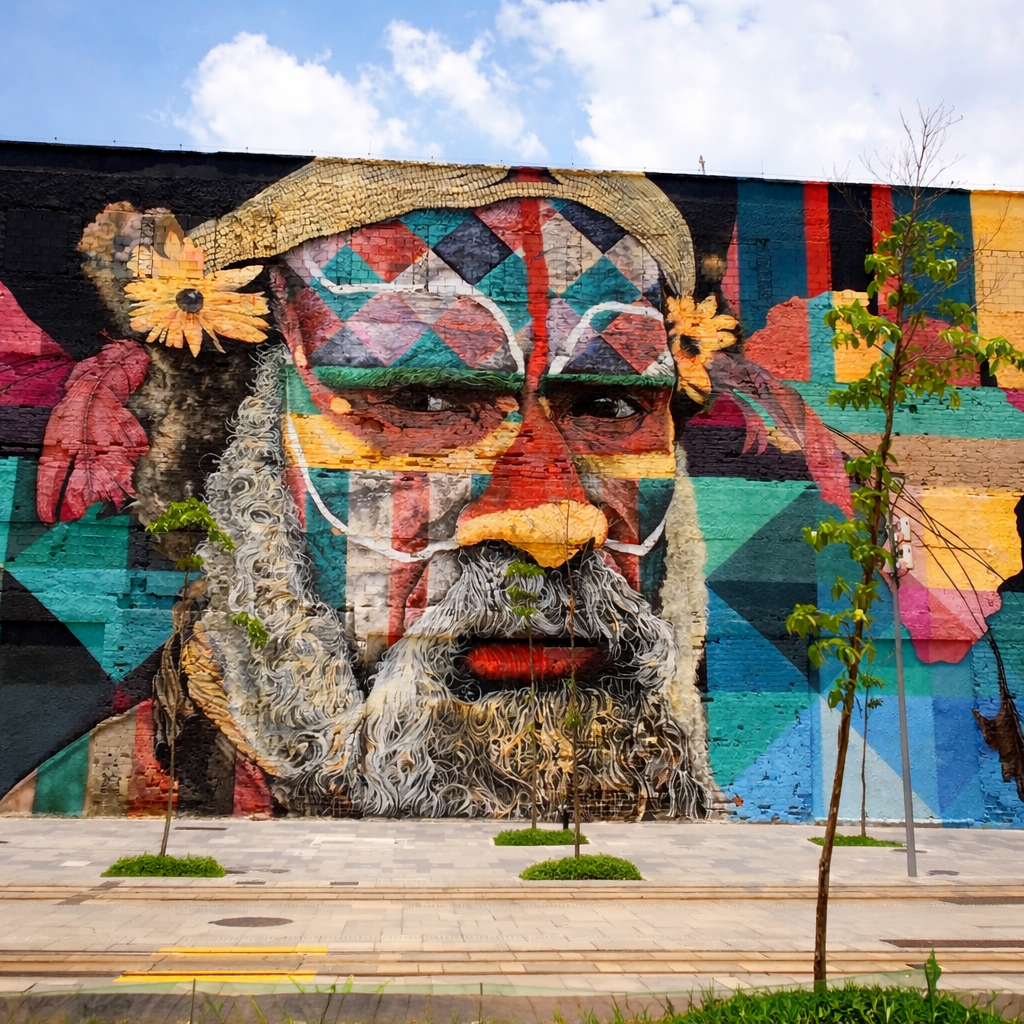
KOBRA mural, Rio de Janeiro. A face of ancient resilience and enduring knowledge
Now, Best Friend is, well, as best as friends can be. We take pride in being brutally honest with each other. Best Friend is trained as a scientist, deeply committed to evidence, method, and the careful discipline of doubt. It is among the reasons I admire them. It is also, sometimes, what I find myself pushing against. When Best Friend the Scientist speaks, they speak with the confidence of a tradition that has learned to trust only what it can measure.
I am no scientist. But I know enough to question who gets to decide what counts as knowledge. Knowledge that does not need to justify itself in the language of laboratories.
I am a sociologist. I was not trained in laboratories or clinical trials, but in listening to people, to histories, to communities that have survived long before Western science learned to name survival as resilience. I am a South African of Indian descent, raised in a context where healing is rarely an individual pursuit and rarely divorced from spirit, land, or relationship. It is where medicine is not always a pill you take or a clinical procedure you undergo, but a way of living that you practice, through food, ritual, touch, community, and building immunity collectively. These ways of knowing are often dismissed as unscientific because they do not belong to the institutions that have claimed authority over truth.
However, let us not forget that the self-claimed authority of Western science also has a long history of being wrong or incomplete. Smoking was not conclusively linked to cancer until long after people were already living with its devastating effects. Pain experienced by women and other marginalized genders has routinely been minimized or dismissed, with conditions such as endometriosis or chronic pain syndromes taking years, sometimes decades, to be taken seriously. Homosexuality, meanwhile, was classified as a psychiatric illness until 1991, despite generations of queer people knowing themselves to be healthy, whole, and fully human.
In many ways, Western science has had to play catch-up with realities and truths that people have been living with for centuries. Many plant-based medicines, including cannabis, have been used for more than 5,000 years across African, Arab, Asian, and Indigenous American societies[1].
The fact that these practices were not validated through Western scientific institutions does not mean they lacked rigor. It often means they were excluded, dismissed, or actively suppressed. This is largely because Western science has positioned itself as universal while being culturally specific, historically contingent, and deeply entangled with colonial power.
So, when Best Friend the Scientist says CBD does not have scientific support for pretty much anything it is claimed to do, that claim depends entirely on defining science as post-20th-century Western pharmacology, while disregarding thousands of years of empirically grounded plant medicine.
Western science’s extraction of CBD from cannabis reflects a methodological preference for isolating variables. Indigenous knowledge systems, by contrast, work with emergence, or the understanding that effects arise from complex interactions rather than single agents[2]. While CBD as an isolated compound is a modern scientific construct, the effects now attributed to CBD were long accessed through whole-plant cannabis practices that were empirically developed, observed, refined, and transmitted across generations in many Global South societies[3].
Best Friend therefore has a valid point, narrowly, but I see the logic of their argument within the terms they were using. CBD, as an isolated compound extracted and studied through Western biomedical frameworks, does indeed have a limited and uneven evidence base. But this precision is also revealing. CBD is not a timeless substance waiting to be discovered. It is a product of Western science’s tendency to fragment plants into marketable molecules. What Best Friend was, perhaps unintentionally, saying is that isolated CBD as a molecule[4], studied through modern clinical trials shows limited and uneven evidence. Whole cannabis, as a lived, embodied experience, is empirically persuasive to them.
That distinction actually supports my broader critique because it exposes how Western science fragments what older knowledge systems held holistically. And what this holistic knowledge has held for centuries, is that medicinal plants such as cannabis, inclusive of the CBD component, have brought healing patterns of relief, calm, reduced inflammation, and restored balance.
Now, some might call this irresponsible or dangerous. Some might belittle this to practices of superstition or hallucinatory thoughts. Others might even dismiss this as outright foolishness and delusion.
On a bitterly cold January morning, bustling with anticipation, poet Cornelius Eady stepped up to the inauguration podium for Mayor Zohran Kwame Mamdani. The city had gathered to mark a moment many once thought unimaginable: New York welcoming its first Muslim mayor of Indian descent, a young and, until recently, little-known assemblyman who had overturned an entrenched oligarchy and pulled off one of the most startling political upsets in the city’s history.
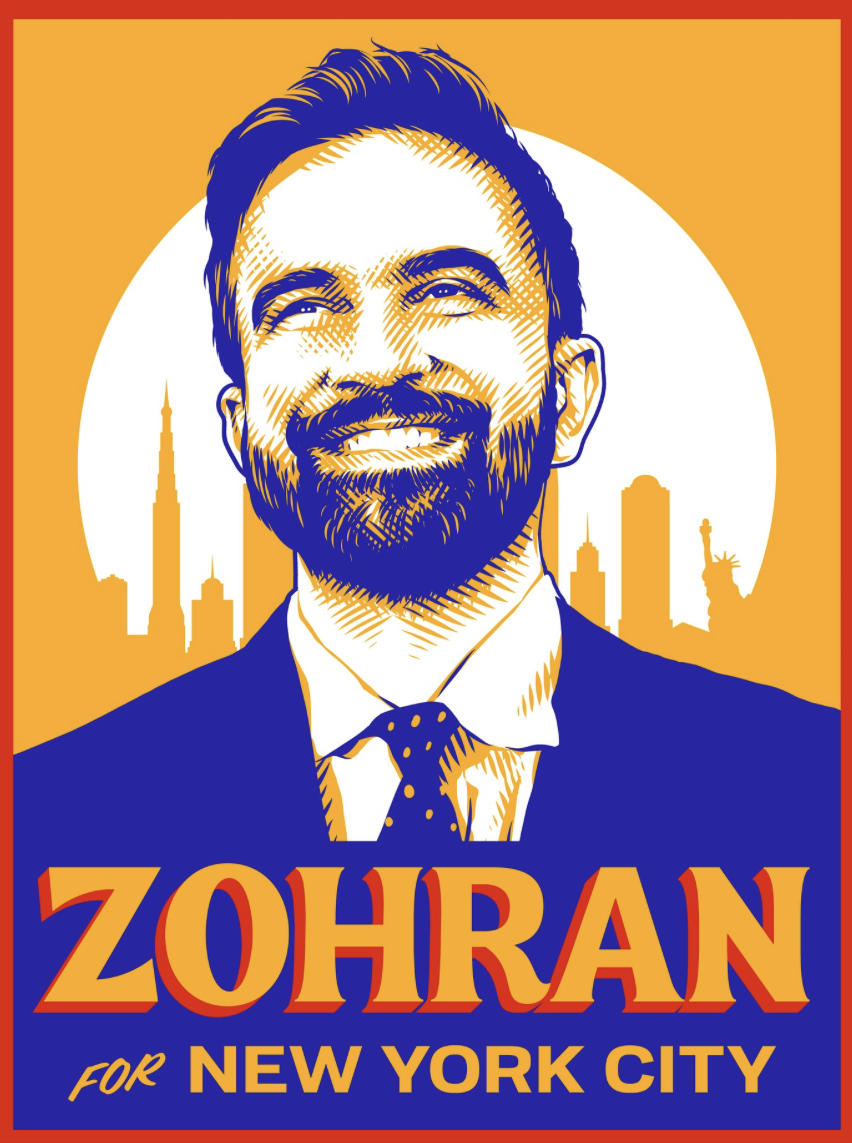
Mamdani mayoral campaign artwork
The cold looked almost symbolic. The air seemed sharp, the kind that stings the face and stiffens the hands, as though the weather itself were underscoring the improbability of the day. Eady sensed it too. Pausing, he joked that somewhere along the long road of the campaign, someone must have said, “Him? He’ll get elected… when hell freezes over.” Laughter rippled through the crowd, bright and immediate. It was the kind of laughter that warms you from the inside, the kind that reminds you that being together matters, especially when circumstances insist otherwise.
People stood bundled in coats and scarves, breath visible in the air, yet the mood carried an unmistakable warmth. Against the cold, there was closeness. Against disbelief, there was shared recognition. What had once seemed impossible had arrived, and the city had come out to witness it together. In that shared warmth, many felt the early signs of a different kind of political life beginning to take shape.
That sense of shared warmth did not end with the laughter or the applause but pointed toward a deeper shift people had been feeling, one that had been quietly building throughout the campaign and was now finding its public voice.
What many were responding to was a change in tone. Public life began to feel less armored, more open to care. People spoke about kindness without irony. They noticed an easing in conversation, a readiness to listen, a renewed capacity for generosity toward one another. Leadership, in this emerging vision, felt grounded in emotional presence as much as in policy, and politics began to feel like a space where human connection could breathe again.
That change in tone became most visible in moments that were small, unscripted, and deeply personal. During one of Zohran Mamdani’s public listening sessions, held without fanfare and away from the spotlight of the inauguration, a woman named Samina took her seat across from him.
Samina had moved to New York from Lahore, Pakistan. She held notes in her hands and began by apologizing for her English, speaking carefully and with intention. She told him she wanted to thank him for what she had been noticing since his election. Faces around her seemed gentler. Daily encounters felt less tense. She said his presence in public life had brought softness into people’s hearts during a time marked by strain and uncertainty. When Mamdani responded to her in Urdu and acknowledged her journey, he grew emotional. Tears gathered in his eyes as he listened. The exchange lasted only a few minutes, yet it carried the weight of recognition. Samina’s words named what many others had been sensing and struggling to articulate: that leadership can restore warmth to civic life simply by meeting people where they are.
Samina’s words lingered because they felt familiar in a deeper way. Her recognition of care in leadership echoed a longing that has surfaced across cultures and centuries. People have always noticed when those who hold power listen closely and allow their hearts to remain open. Long before modern elections and public offices, communities told stories to preserve the memory of such rulers.
In South Asian history and folklore, Razia Sultana endures as a ruler remembered for her visibility and openness. She appeared in public spaces, listened to grievances directly, and carried the responsibilities of rule with humility and resolve. Her leadership left an imprint because it remained close to the people it served. In Persian tradition, King Anushirvan lives on as a symbol of justice shaped by attention to ordinary lives. Stories recount how he walked among his people, listening to farmers and laborers, learning how policies touched daily survival. His authority grew from fairness and steadiness, and his name became shorthand for a reign grounded in care.
These figures appear again and again in cultural memory, sometimes through chronicles, sometimes through poetry and storytelling. Their presence reminds us that ethical leadership has always depended on proximity, listening, and a willingness to be shaped by the lives of others. When Samina spoke, she gave voice to this same understanding. She recognized a quality of care that societies have long held up as worthy of remembrance, one that continues to reappear whenever power is exercised with human attention.
These rulers remain present in memory because their stories were carried forward, told and retold in homes, courts, and marketplaces. Over time, ethical leadership took on narrative form, becoming part of the shared imagination. This is how figures like Anushirvan and Razia Sultana moved beyond their own eras and entered a wider cultural vocabulary about care and responsibility.
That same vocabulary appears vividly in The Thousand and One Nights. In its stories, rulers leave the safety of their palaces and walk through their cities, listening to the lives unfolding around them. They hear grievances in kitchens and courtyards. They learn how policies ripple through households and livelihoods. Wisdom grows through attention. Justice follows from closeness. These tales endure because they offer a clear insight: societies change when power stays near the people, when leadership remains porous to human experience.
Seen this way, Samina’s encounter feels part of a much longer story. Her words echo the same recognition that animated these narratives centuries ago. She sensed care where others might overlook it. She named softness as a civic force. In doing so, she reminded us that leadership grounded in listening has always been one of the ways trust is restored and collective life renewed.
This lineage helps explain why Mamdani’s example resonates beyond one city. When people witness leadership shaped by attention and humility, it unsettles long-held assumptions about authority. It invites comparison. It raises expectations. Across borders and political systems, people recognize the familiar contours of ethical rule when it appears. They measure their own leaders against it. In this way, one example begins to travel, quietly but insistently, carried by shared human memory.
That sense of continuity, of memory carried forward, was articulated in Cornelius Eady’s poem on that cold January morning. The poem felt like an offering made into a shared space, shaped by the same attention and care that had drawn people there. Eady’s words reached for those whose lives are so often pushed to the edges of public life and brought them into the centre of the moment.
He asked questions that many of us have carried quietly for years:
Who said you were too dark?Too large, too queer, too loud?Who said you were too poor, too strange, too fat?You have to imagine it.Who said you must keep quiet?Who heard your story then rolled their eyes?Who tried to change your name to invisible?
The poem, aptly entitled Proof, held these questions without rushing to answer them. It allowed recognition to settle in the body. Standing together in the cold, people felt themselves named and seen. The words gathered those who have been dismissed, corrected, overlooked, or erased, and placed them squarely within the civic story of the city. In that act of gathering, softness became visible as a form of strength. Care took on public shape.
This was the same moral lineage traced through stories of rulers who listened closely and governed with humility. It was present in the laughter that rose when Eady spoke of frozen hells and improbable victories. It lived in the simple fact of people showing up for one another on a freezing day.
That is the proof. Proof that shared attention can restore warmth to public life. Proof that leadership shaped by care can bring people together across difference. Proof that softness, long pushed aside, has found its way back to power.
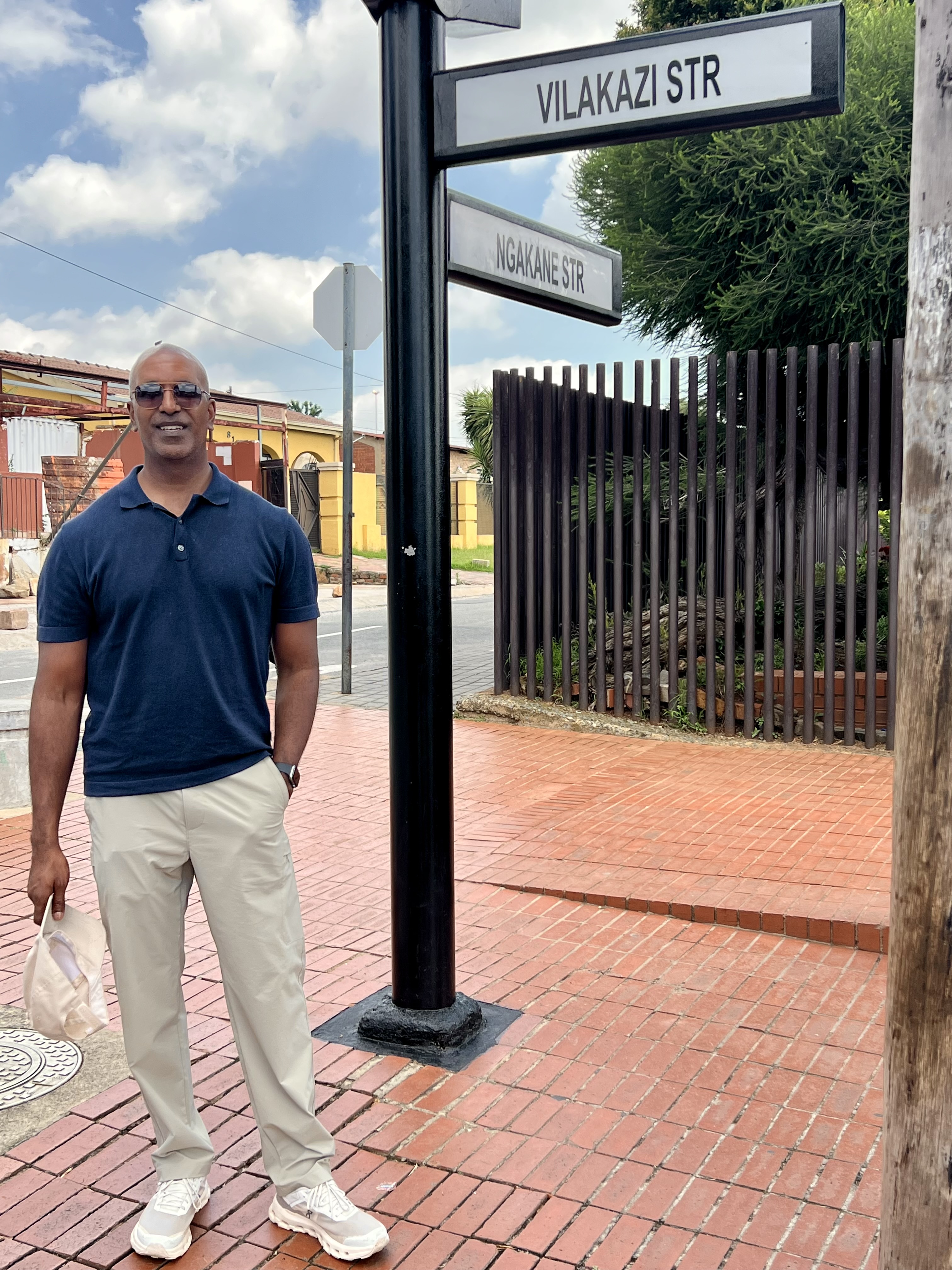
I went to Vilakazi Street precinct to see the Hector Pieterson Memorial, carrying with me a quiet reverence that had been forming for years. June 16, 1976 has always lived in my imagination as a moment of terrible courage, of adolescents whose lives were interrupted so completely that resistance became the only means of growing up. More than just being a tourist, I wanted to stand before the memorial as a witness, as one paying attention to a sacrifice that still asks accountability of the present.
But I never reached it.
It was early in the morning, before the shops and restaurants opened, and before other visitors arrived. Vilakazi Street precinct, usually animated and reassuring in its busyness, felt temporarily unguarded. Its openness was exposed rather than welcoming. A group of young men approached my partner and me. They greeted and performed a piece of rap that they composed. They were playful at first, then started to ask for money. When we explained that we didn’t carry any cash, they did not move. They stayed close. They followed as we walked.
What unsettled me was not the request itself, but the refusal of distance. The interaction did not resolve. It lingered. The street was quiet enough that there was no social buffer, no witnesses, no easy way to disappear into a crowd. My body registered the change before my thoughts did. There was a tightening, a calculation, a sense that the situation could tip suddenly and without warning. We turned back toward the main precinct, choosing safety over intention, aware that we were retreating from the encounter with memory we had sought.
This was not paranoia, nor moral judgment. It was a plain, physical awareness of vulnerability, of being outnumbered, of being watched, of not being able to predict what would happen next.
The memorial remained unseen, just beyond reach.
What stayed with me afterward was the contrast it exposed. The youth of 1976 appear in our national memory as brave, morally luminous figures. They were children who gave up their childhoods to confront an unjust system. The group of young men we encountered that morning elicited no such admiration. They stirred fear, even resentment. Where I expected reverence, I felt vulnerability. Where I sought moral clarity, I encountered discomfort.
This contrast is tempting to simplify, but it resists easy judgment.
Memory often works by distance. We remember the past by smoothing its edges, by transforming chaos into meaning. The youth of June 16 have been folded into a narrative of sacrifice and heroism that allows us to honor them without confronting the full terror of their circumstances. Memory grants them dignity but it also freezes them. They remain forever courageous, forever legible, forever deserving.
Fear works differently. It is immediate, bodily, untheorized. When fear enters, moral reflection narrows. The youth who approached us were not symbols. They were unpredictable presences. I could not hold them gently in thought because I was busy calculating escape routes. Fear does not ask who someone is within history. It asks what they might do in the next ten seconds.
This is where moral distance emerges.
The youth of 1976 feel close to us emotionally because they are safely far away in time. The youth of today feel distant because they are uncomfortably near. One group reached us by memorials, photographs, and stories, while the other confronts us by instinct, risk, and self-preservation. One invites empathy without cost, while the other demands it under pressure.
And yet, the space they occupy is the same.
Vilakazi Street precinct holds memory and aftermath side by side. The memorial asks us to pause, to reflect, to honour a struggle that promised a different future. The living street insists that the future arrived unevenly. Liberation ended a system, but it did not complete a moral project. The young men we encountered do not negate June 16 inasmuch as they are part of a struggle that is still unresolved.
What unsettles me most is how that unresolved struggle made itself felt there, in a place meant to anchor courage. Turning back felt like a small personal failure, but also like a revelation. I could not reach the memorial because the conditions it stands against have not been fully dismantled. The path to remembrance was blocked not by malice, but by neglect, inequality, and the long shadow of unkept promises.
Perhaps that is the harder truth that the Vilakazi Street precinct told me.
The memorial commemorates adolescents who were forced to grow up too soon. The youth I met are growing up in a society that does not know what to do with them. One group is remembered because they died in the clear violence of apartheid, while the other survives within quieter, less visible structures of economic and social injustice, in ways that unsettle us. The distance between them is structural rather than moral.
I did not get to stand before the memorial. Instead, I stood inside the contradiction it represents. And maybe that, too, is a form of witnessing. Perhaps there is also a need to acknowledge reverence interrupted by fear, admiration strained by reality, and to leave knowing that remembrance without responsibility is incomplete. The Vilakazi Street precinct did not fail me. It refused to let memory stand alone.
When a government refuses to confront inequality, it builds a wall. It is easier than justice, faster than reform, and far less uncomfortable than asking why crime exists in the first place. The City of Cape Town’s proposed ZAR180 million wall along the N2 is being sold as a safety measure. In reality, it is a design choice rooted in fear, optics, and a long tradition of pretending that poverty disappears when it is hidden from sight.
Table Mountain stands close enough to see, and far enough to deny an entire generation access to the city beneath it.
This kind of decision never exists in a racial vacuum. In South Africa, walls do not simply divide space. They divide bodies, histories, and assumptions. The communities being screened off along the N2 are overwhelmingly poor and overwhelmingly Black. The message is intentionally wrapped in the neutral language of “risk mitigation” and “public safety” but it is nonetheless blunt: danger lives there, and safety belongs here. Crime is racialised by geography, and poverty becomes a visual contaminant to be managed rather than an injustice to be addressed.
This is where the wall goes beyond being offensive, and starts becoming familiar. Fascist movements have always understood that separation does half the ideological work for you. You do not need to convince people that others are dangerous if you can simply place a barrier between them. Walls externalise fear, harden prejudice, and erase context. They turn political failure into architecture and call it order.
The City insists that the wall will stop stoning incidents and criminal attacks on vehicles entering Cape Town. This is security theatre dressed up as urban planning. It assumes crime is static, unimaginative, and spatially obedient. It ignores the rather well-documented reality that criminals tend to go around, over, under, or through obstacles placed in their way. Sometimes they bribe. Sometimes they adapt. Sometimes they operate from the “safe” side of the wall entirely.
A wall does not dismantle criminal networks. It does not interrupt supply chains. It does not address motive, opportunity, or organisation. It simply moves the problem out of sight, which is, of course, the point.
This brings us to the most corrosive lie underpinning this project, that low-income communities produce criminals. More than being just wrong, it is also lazy, dangerous, and morally bankrupt. We do not know who these criminals are. We do not know where they come from, how they operate, or who benefits from their actions. Crime in South Africa is not a spontaneous chemical reaction triggered by poverty. It is structured, organised, and often profitable. To collapse this complexity into a moral judgement about low-income communities is quite simply scapegoating. Worse still, it blames people who are themselves the most exposed to violence.
The communities along the N2 are saturated by crime. They live without the buffers that wealth provides. They do not have private security patrols, high walls topped with electric fencing, nor rapid-response panic buttons. When crime happens there it does not become a headline because it is a condition of daily life. And yet somehow, such communities are framed as the threat rather than the threatened.
This is where the City of Cape Town’s moral priorities become impossible to ignore.
The urgency around this wall did not emerge because residents of these communities are unsafe. It emerged because tourists are. The crisis is not violence itself, but violence that interrupts the airport corridor, the welcome mat, the first impression. When locals suffer, the city shrugs and cites complexity. When visitors feel uneasy, budgets are magically unlocked and the concrete mixers roll in.
Tourist safety is treated as an economic imperative. Local safety is treated as an unfortunate complication. And so, we arrive at the real function of the wall. It is not about protection. It is about erasure.
The wall is meant to stop visibility, to hide poverty from passing eyes, to preserve the illusion of a “world-class city” untroubled by the realities that sustain it. This impulse, to sanitise space, to prioritise aesthetics over justice, to bulldoze truth in the name of development, has become a defining feature of Cape Town’s governance.
We have seen it in the city’s hostility to the Save Our Sacred Lands campaign. We have seen it in the Two Rivers Urban Park development, where community heritage voices about sacred spaces were treated as obstacles rather than stakeholders. Again and again, the same pattern emerges. Dissent is inconvenient, poverty is embarrassing, and development must proceed, even if it requires erasure.
This is neoliberalism flirting openly with authoritarian instincts. It is fascism without the theatre, exclusion without the rhetoric. It is clean, efficient, and devastatingly polite.
The obscenity of this project is sharpened further when one follows the money. ZAR180 million is being marshalled for concrete, steel, and the maintenance of denial. We are told, endlessly, that meaningful solutions to crime are too complex, too expensive, too difficult to implement.
This is simply not true. The truth is far more uncomfortable. Walls are chosen because better solutions would require the city to see people living in poverty as worthy of safety even when no tourist is watching. That refusal, to recognise dignity without an audience, is expressed in budgets, in planning decisions, and in what the city repeatedly chooses not to fund. And it is precisely here that the wall collapses as a solution and reveals itself as a choice.
The same funds earmarked for a wall could be used to strengthen community capacity, organisation, and agency. These are the elements that actually produce safety over time. Community-based safety workers, mediators, and first responders drawn from local neighbourhoods are sustainable solutions to crime and violence. Their effectiveness lies in presence, relationships, and accountability because they are forms of safety that cannot be outsourced or poured in concrete. Within a ZAR180 million budget, the city could sustain hundreds of such roles over several years, embedding safety within communities rather than imposing it from the outside.
Investment in youth employment and skills development sits within the same logic. Cities that have meaningfully reduced violence have done so by expanding people’s stake in their communities and their futures. Medellín[1] is particularly instructive because it reorganised power and possibility. By investing in education, mobility, public space, and local enterprise in historically marginalised areas, the city enabled young people to participate as producers of the city. Safety emerged through inclusion, opportunity, and shared ownership of place.
Culture played a central role in this process. Music, visual arts, dance, theatre, and community media were engines of mobilisation and cohesion. Cultural programmes created spaces where identity could be expressed, solidarity built, and public areas reclaimed. Youth orchestras, hip-hop schools, arts centres, and neighbourhood festivals strengthened social ties and made communities visible on their own terms. These initiatives displaced violence by filling public space with meaning, activity, and collective presence.
The same principle underpinned Glasgow’s[2] shift toward treating violence as a public issue rather than a moral defect. Community-led interventions, long-term investment in people, and a recognition of shared responsibility reshaped how safety was produced and sustained. In both cases the lesson is direct, which is that communities become safer when they are empowered to organise, care for one another, and shape the environments they live in.
Strengthening trauma-informed health services, substance-use support, and victim assistance fits squarely within this framework. Violence fractures social bonds. Repairing those fractures is part of rebuilding safety. Care, culture, and opportunity are therefore the foundation of community safety and security.
These are tested approaches to safety that are grounded in community agency, shared ownership, and sustained public investment. The question for Cape Town is why they are so readily dismissed in favour of concrete and concealment.
Safety and wellbeing is produced when communities are resourced to organise, to care for one another, and to shape the spaces they inhabit. This is slower work than pouring a wall, but it is also the only work that lasts.
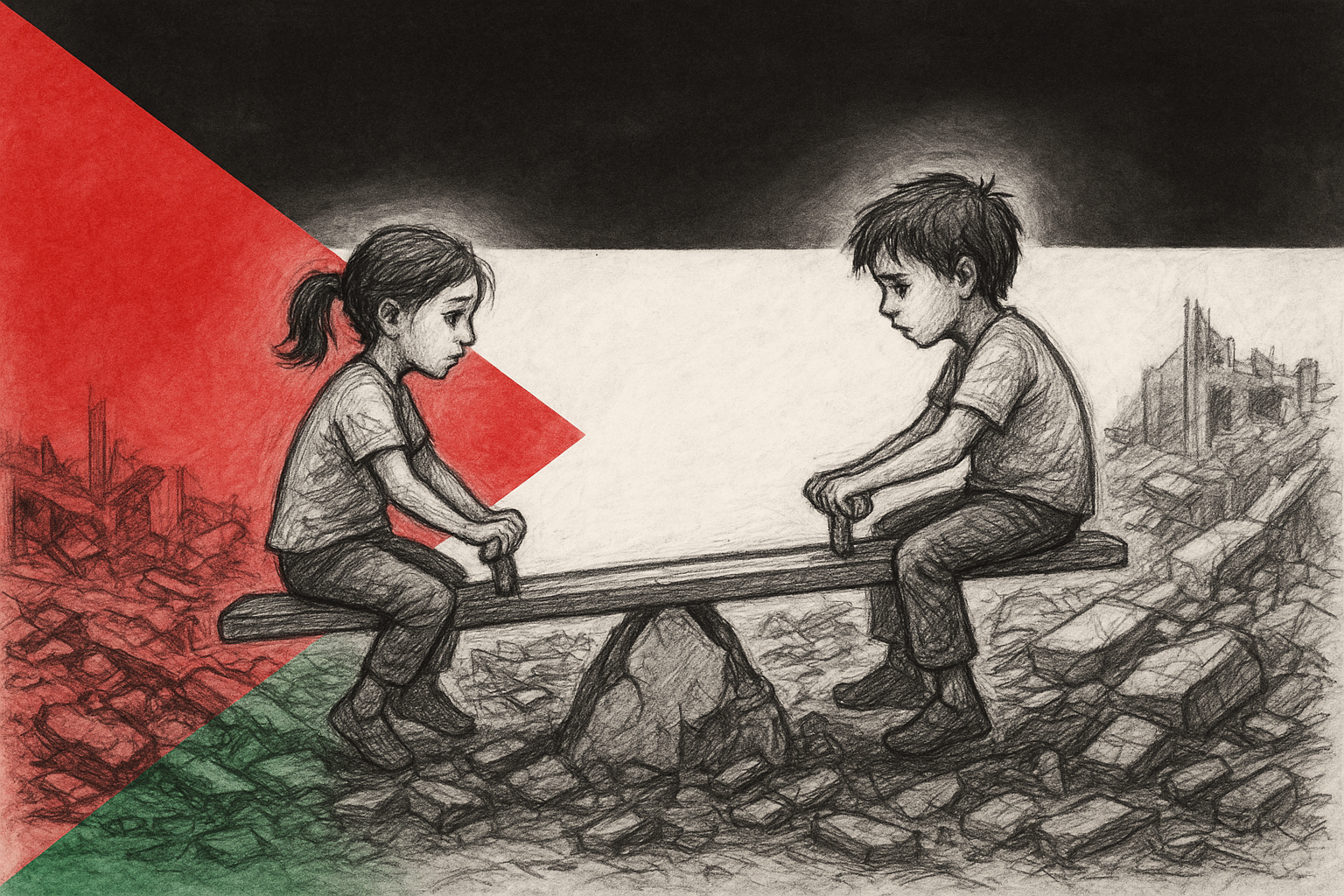
We have all been watching Palestine for decades. We have witnessed the blockade by Israel, the bombings, the rubble. We have seen the images of children deliberately targeted and killed, children with bandaged limbs, children pulling siblings from collapsed buildings, children writing in notebooks beside the ruins of their homes. And yet, it is only now, after tens of thousands have been killed, that some in the international community have begun to name this horror for what it is: a genocide.
Why must children bear the burden of our hesitation? Why do we wait so long to call evil by its name? Have we not learnt from history that, in every genocide, children pay the heaviest price?
In Southern Africa, during the 17th and 18th centuries, the genocide of the Khoi and San people began with the displacement of children. Severed from their ancestral lands, taken into servitude and forced to abandon their identity, their erasure ensued relentlessly by colonial powers[1]. With the Herero and Nama people, in the early 1900s, children were deliberately starved and denied medical care in concentration camps[2]. During the 1994 genocide in Rwanda, more than 300,000 children were killed, and an estimated 95,000 were orphaned in just 100 days. Thousands more were forced into armed groups, carrying weapons instead of schoolbooks, their childhoods stripped away in the violence[3]. Children were also systematically marked and targeted during the holocaust, with more than 1.5 million killed. Those who survived often endured medical experiments or brutal labor, their innocence erased as part of a calculated extermination[4].
In every case, children were not merely accidental victims of violence. They were deliberately targeted because they carry the possibility of a people’s survival. To erase children is to erase the future.
This same pattern has been unmistakably visible in Palestine. At least half of Gaza’s population are children, yet they have been among the most systematically killed and maimed by Israeli forces. Schools, playgrounds, and hospitals, as spaces meant to shelter the young, have been bombed repeatedly[5]. Countless children have been killed, with more buried under rubble or dying slowly from hunger and untreated injuries. Tens of thousands more are now orphans. This deliberate targeting of children in Gaza is not new, but the scale and sheer brutality is unprecedented.
We ought to recognize by now that the targeting of children is always the first and clearest sign of genocide.
In 1948 the Convention on the Prevention and Punishment of the Crime of Genocide was passed[6], promising “never again.” The convention, while powerful on paper, is however tragically inadequate in practice. It defines genocide legally but is not proactive. It responds after catastrophe, rather than preventing it. It also relies on states to enforce action, but political alliances and veto powers silence urgent intervention. One of the greatest weaknesses is that the convention does not compel response at the first warning signs. The deaths of children become proof of genocide rather than a trigger to stop it. By the time the world officially speaks the word “genocide,” it is already too late for the children buried in shallow graves.
Beyond those who are mercilessly killed, survival is not free of pain. We know very well the trauma of violence that stubbornly lingers well beyond childhood. Studies have consistently shown that trauma carried in childhood shapes generations. These are the ‘living genocides’, the slow, invisible killing of potential, joy, and hope. A girl who grows up without parents, without safety, without security, does not simply “heal” when the bombs stop. A boy who watches his family killed will carry that scar into adulthood, into parenthood, into the raising of the next generation.
Genocide is not only about the killing of bodies. It is about the killing of futures.
If we are indeed committed to “never again,” then the protection of children must be the red line we refuse to cross. What would it mean to rewrite our conventions with children at the center?
Early-warning triggers: If children are being targeted, displaced, or denied food, water, or medication, this should automatically initiate international investigations and interventions.
Mandatory protections: Bombing schools and hospitals should immediately trigger accountability mechanisms, without waiting for political approval.
Humanitarian corridors: Guaranteed, enforced pathways for children and families to access food, water, and medical care, even and especially against state objections.
Accountability: Leaders who order or enable the harming of children must face international justice swiftly, not decades later.
Denouncing hate speech: As a known precursor to genocide, dehumanizing rhetoric should be addressed through punitive action against those using and spreading derogatory terms about specific population groups.
Perhaps the Genocide Convention already contains these principles in theory, but in practice, it has been ineffective. The world does not need more words. We need proactive legislation that protect children before their futures are destroyed.
Genocides expose the worst of humanity, not only in the cruelty of perpetrators but also in the apathy of bystanders. To remain silent while children are killed is not neutrality; it is complicity. To abstain from naming genocide is to allow it to continue.
Children should not have to carry the weight of our hesitation. We must act when it matters most. For the sake of our children, we can never hesitate to call evil by its name and confront it with all the courage humanity owes its future.
Written by Merlin Ince
[1] Adhikari, Mohamed. The Anatomy of a South African Genocide: The Extermination of the Cape San Peoples. Ohio University Press, 2011.
[2] Olusoga, David & Erichsen, Casper W. The Kaiser’s Holocaust: Germany’s Forgotten Genocide and the Colonial Roots of Nazism. Faber & Faber, 2010.
[3] Human Rights Watch, Rwanda: Child Soldiers, 2003.
[4] United States Holocaust Memorial Museum (USHMM), “Children During the Holocaust.
[5] UN OCHA, Occupied Palestinian Territory: Hostilities in Gaza, situation reports, 2023–2024.
[6] UN Office on Genocide Prevention and the Responsibility to Protect, The Genocide Convention.
The crown that says: Unite the Kingdom… but keep the jewels.
Photo: “Imperial State Crown.png”, Wikimedia Commons — Public Domain
When I first stumbled upon the slogan Unite the Kingdom, I must admit that I was quite charmed. Finally, I thought, this is the start of a campaign to stitch together all the countries torn apart by centuries of colonialism. How wholesome! I thought of a global support group where India, Nigeria, Jamaica, Kenya, South Africa and countless others sit around in a circle with Britain, sipping tea (fair-trade, of course), while mending the historical wounds inflicted by Britain’s globe-spanning land grab. But alas, forgive me. I was naïve. I really believed, for a fleeting second, that Britain had collectively decided to atone with a little kumbaya.
So, upon further reading I found that Unite the Kingdom is not a worldwide reconciliation festival. It is, in fact, a nationalist protest against immigrants, a movement that seeks to pull up the drawbridge and lock the gates. The very same Britain that once sailed across the seas planting flags in lands they couldn’t pronounce now insists that their borders must remain sacred and untouched. This is the country that looked at entire continents and thought, “Nice place, ours now.” They called it the Kingdom, extended it across vast oceans, and yet today, the descendants of that empire tremble at the thought of outsiders settling in their neighborhoods. History has never been so hypocritical, or so short of memory.
But let’s take a step back and play a little with the idea I had before I was rudely awakened. What if Unite the Kingdom really was about solidarity? Imagine a Britain that did not just wave flags and chant slogans, but actually opened its arms to the very people it once ruled. Imagine a Britain that said, “We are sorry about those centuries of exploitation. May we join forces to build a better future?” Outlandish, I know, but our imaginations are created to run freely so let’s go.
First, imagine cultural reinvestment. Instead of immigrants being scapegoated, the so-called Kingdom could finally acknowledge that its curry is better than its shepherd’s pie, and that its music, literature, and fashion owe just as much to Lagos, Kingston, and Mumbai as they do to London. A “united kingdom” in this sense would be a vibrant patchwork quilt, where the threads are made stronger by recognizing mutual debt rather than pretending one side invented everything.
Second, economic justice. Britain could actually return resources it once extracted. I am thinking, for instance, of the Cullinan diamond. It is the massive gem taken from South Africa and cut into pieces, one of which now sits smugly in the Imperial State Crown. Imagine if Unite the Kingdom meant returning stolen treasures, re-investing colonial profits in education and healthcare abroad, and creating equitable trade systems. Britain could stand up at the United Nations and say, “We’re here to give back, not take.” Can you imagine the shock? The applause? The memes?
Third, a world where migration is not demonized but celebrated, where the great irony is flipped inside out: the British once wandered the earth looking for opportunity (and gold, and spices, and, well, diamonds), so why can’t today’s migrants do the same without facing hostility? If Unite the Kingdom were reimagined, the narrative would shift from “they are taking our jobs” to “we are building a bigger table.” The empire took enough seats, so surely there are some left to share.
In this version of reality, “uniting” is not about shoving people out. It is about finally making good on the centuries-old promise Britain declared when it drew those pink patches across the globe: that we are all part of something bigger. To unite the kingdom in any real sense, there is a price of admission. Britain would have to look at its crown, that gaudy symbol of conquest, and say: Unite the Kingdom… and give back the diamond!
Neatly and comfortably packaged classifications are often suspicious, especially when they are stamped on complex lived experiences. Shorthand labels like low-income country (LIC), lower-middle income country (LMIC), upper-middle income country (UMIC), and high-income country (HIC) feature prominently in global health and development discourse. These terms were designed as statistical categories, but in practice they have become proxies for assumptions about need, capacity, and progress. They have also come to shape how funding is allocated, how research priorities are set, and even how we imagine people’s daily lives across continents.
What happens, though, when these neat categories conceal more than they reveal?
South Africa is one of the stark examples in this regard. The upper middle-income classification suggests, on paper, relative prosperity. It has come to imply that development aid is no longer necessary. The less comfortable and more messy reality, however, is that South Africa is the most unequal society in the world with a Gini coefficient of 0.671.
Even more shocking is South Africa’s Palma ratio. This is the ratio of income share of the top 10% to that of the bottom 40%. While some low-income countries have a Palma ratio of around 1.2 to 2.6, South Africa has a ratio of 72. It is considered obscene inequality, with the wealthiest 10% earning approximately seven times more than the poorest 40%. It underscores the savage concentration of resources and the systemic neglect of the majority, often evidenced in maternal health and early childhood development narratives.
South Africa’s maternal mortality ratio remains stubbornly high, higher than some low-income countries in sub-Saharan Africa. Its child stunting rates, a marker of chronic malnutrition, rival or exceed those of nations with GDP per capita less than half of South Africa’s. Access to quality education is similarly bifurcated, with elite private schools boasting global standards, while vast numbers of public schools operate without libraries, laboratories, or even reliable toilets3.
With the ill-fitting but nevertheless neat classification of “upper-middle income,” donors often tend to look elsewhere, assuming that South Africa can take care of itself. The perception ignores not only inequality but also the deep structural legacies of apartheid, where race, displacement, and economic exclusion still determine life chances. The result is that communities most in need are left underserved, precisely because the classification system tells the world they are no longer “poor enough.”
South Africa is not alone. Other countries also uneasily bear their assigned categories, hiding enormous disparities beneath a statistical average.
Brazil is another upper-middle income country, with one of the largest economies in the world. Still, many communities face ongoing violence, food insecurity, and poor sanitation. The life expectancy gap between wealthy and poor Brazilians can be decades apart. Maternal mortality rates in Brazil’s northeast, which is home to Afro-Brazilian communities historically excluded from wealth, remain high and resemble those of much poorer countries. Between 2017 and 2022, Brazil’s national maternal mortality ratio (MMR) averaged 68.0 per 100,000 live births. Black women, however, faced nearly double the risk compared to White women: 125.8 vs. 64.2 respectively4.
India, classified as a lower-middle income country, has a booming tech sector, a space programme, and billionaires whose fortunes rival those in Silicon Valley. It also has some of the worst child malnutrition statistics globally. Entire regions, particularly rural areas, continue to struggle with preventable diseases, high maternal mortality, and underfunded schools. The average GDP figure hides the fact that 230 million people live on less than $1.90 a day5.
Nigeria, Africa’s largest economy, is classified as lower-middle income. Oil wealth and a vibrant urban middle class project an image of prosperity, but Nigeria is home to over 90 million people living in extreme poverty. Maternal mortality rates are among the highest in the world, and vast disparities exist between the urban elite and rural communities. In 2023, Nigeria suffered 75,000 maternal deaths, accounting for nearly a quarter to a third of global maternal deaths. A regional breakdown reveals draconian inequality, with a woman in north-east Nigeria being 10 times more likely to die in childbirth than a woman in the south-west6.
The danger of comfortable classification labels is that they shape the flow of resources and the scope of intervention. Many donors and international agencies use income classification as a crude eligibility filter. Countries like South Africa and Brazil are excluded from certain types of aid, under the assumption that they have “graduated.” Global health studies often concentrate on “low-income” countries, leaving out populations in middle-income countries that face equal or greater risk.
This skews evidence and reinforces blind spots. International recognition of inequality is too often confined to rhetoric. The persistence of categories like “upper-LMIC” allows policymakers to sidestep difficult questions about redistribution, justice, and the politics of exclusion. By using GDP averages as shorthand for development, we end up reproducing the very inequalities we claim to fight.
If we are serious about addressing human need, we must rethink how we classify countries. GDP per capita is a blunt instrument that obscures more than it illuminates. Alternative measures exist, such as the Multidimensional Poverty Index, inequality-adjusted Human Development Index, and disaggregated national statistics, that provide a more nuanced picture.
Development discourse must stop equating national wealth with social well-being. Inequality is a defining characteristic of modern economies, and it is often the main driver of poor health, poor education, and poor life chances. Funders and policymakers need to ask harder questions: Who is left out within these “middle-income” countries? Whose suffering remains invisible while averages tell a story of progress? How can aid and policy mechanisms reach those who live in wealth-shadowed poverty?
The point is not to shame or to single out any one country. South Africa, Brazil, India, and Nigeria are all navigating complex histories of colonialism, exploitation, and rapid growth. The common thread here is the way global classifications erase inequality, leaving millions effectively invisible to international solidarity.
It is time to name this masking for what it is. It is a failure of imagination. It is a refusal to look beyond averages. To call South Africa “upper-middle income” and stop there is to indulge in comforting fictions while ignoring the daily crises of maternal death, malnutrition, and failing schools. The challenge to funders, policymakers, and global institutions is simple but urgent. It is a call to move beyond the shorthand, to recognize inequality, and to not let the language of classification become a justification for neglect.
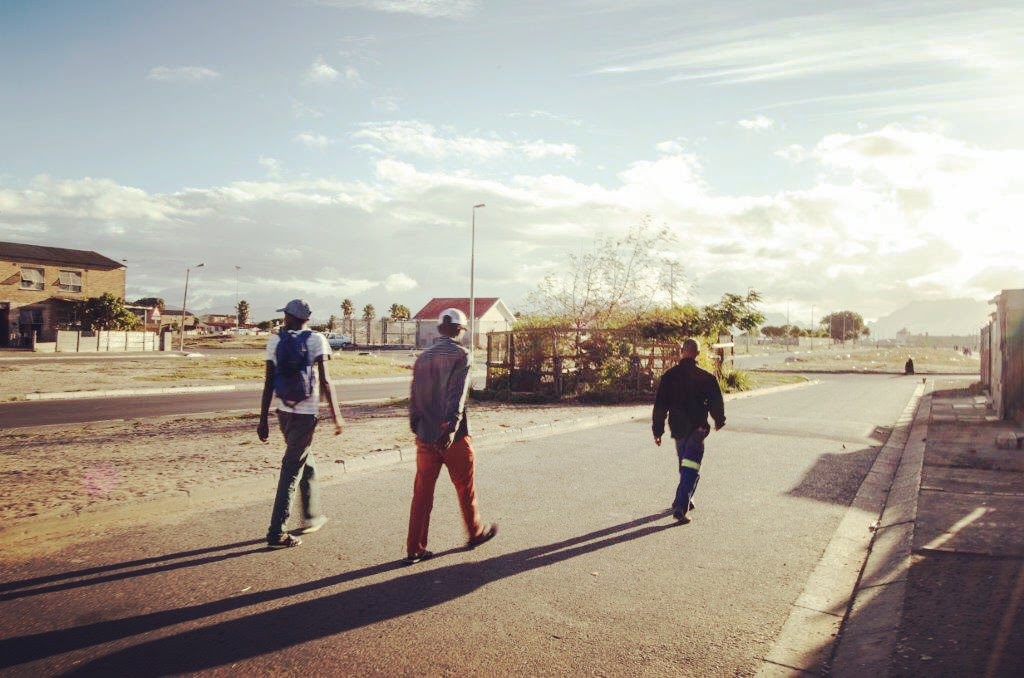
Youth setting out to work an evening shift as the sun sets on the streets of Manenberg
On a quiet and chilly July afternoon I headed out to Manenberg for a research interview. I was meeting with youth and their families, listening to stories about how they encounter social hardships in trying to find work. Manenberg is an underserved and marginalized neighbourhood on the outskirts of Cape Town. As a relic of the apartheid-engineered city, residents still bear the contempt and pain of being forcefully removed and resettled on these dusty windswept plains of the Cape Flats.
Manenberg’s bustling streets were virtually abandoned on this afternoon, either an ominous sign of a gang fight or a more tempered measure of taking cover from the cold especially since the first rains had fallen. I decided to follow the cue from the presence of fruit sellers who would not have set up shop in the event of any impending unrest. I take my chances, as people do everyday in Manenberg.
I walk out from one of the apartment blocks, and I am cautioned by the nervous gesture of a young man approaching me. We are on opposite sides for now, of the fence that cordons the territory of the block. He is outside and I am on the inside. He stops and takes a step back. His gaze is steady on me but I drop mine to counter his engagement. He persists. “Are you an American” he calls out, referring to one of Manenberg’s most notorious gangs called The Americans. I laugh nervously, realising the poignant intent of such a question in territory ruled by the rival Hard Livings gang. “No,” I respond feebly, “No I am not.” He continues towards me and we pass at the gate. He glances over his shoulder, “I thought you were an American coming to kill me.” And then with him now on the inside of the fence and I on the outside, he turns to triumphantly announce words that numb me, “I do the killing around here.”
People who straddle marginal identities, particularly gangsters, often display a certain contempt that disturbs us who are outsiders. We interpret it as a cold disregard for mainstream society values and this is what shocks, abhors and horrifies us. We do not live in their world. We live far removed from the brutal realities that have turned little boys playing soccer on the street into knife-and-gun-wielding criminals. And because we live so far away from this world, we do not understand.
This is not an attempt to condone heinous crimes. It is rather an endeavour to discern what breeds such contempt in the hearts and minds of young men who belong to gangs. Brazilian author Jorge Amado, in his most famous novel, Captains of the Sands, gives an evocative portrayal of a group of street children who operate as a gang, thieving out a living on the streets of Salvador de Bahia. Amado navigates this gritty story with a delicate hand, as a constant reminder that these are little children who have been orphaned and abandoned by the social structures that favour wealth and prestige. The empty warehouse in which they live is a metaphor of the loss they have suffered, of their families and of the comforts that every child deserves in order to know what it is like to belong. Instead they are savagely beaten and punished by police authorities and the staff of so-called reformatories. What they long for is the affirming touch and embrace of a mother’s hand, or the warmth of a nourishing meal and a bed to dream the dreams that keep hope alive: “All of them were looking for affection, anything out of that life.”
I don’t think that anyone ever chooses freely to live a life of killing, thieving, or hurting other people unless you are consumed by emptiness, when comfort and love seem like elusive luxuries that you are never entitled to. It becomes a hard and heartless life, as a young man in Manenberg explains about his marginal identity as a gangster. He speaks plainly, with determination and no need for apology, about what it means to defend one’s pride and dignity when you do not have much to hold on to: “Don’t come running and try to pull me, no. I will hit you. I will make you very sore, you see. You can make me also sore and I don’t care… You gonna stab me, you gonna shoot me, it gonna heal again but the feeling inside can’t heal, my brother, you see no-one can heal this what you feeling inside…”
The youth whose stories I listened to over a four-year research period have offered a unique insight into the complexities of having dreams, talent, and ambition, yet having to contend with circumstances beyond their control that go against their aspirations. Youth who experience anger, frustration, despondency, often express this through external behaviour that does not convey a holistic understanding of their day to day experiences. When such youth are given an opportunity to tell their stories, we create a space for them to be seen and understood in a new light such that their plight may receive appropriate responses that are geared towards strengthening their agency to defy and transform their circumstances.
Perhaps one of the most telling examples of how structures impact on the way in which youth navigate education and employment is related by one of the young people from my research journey. Jennifer was filling out an application form for a training college programme and was required to name where she was from: “I didn’t know what to fill in there. It asked what suburb or township I am from and I thought, well I don’t live in a township or a suburb. I live in a ghetto. It is rough here. Will they even understand that?” This question lies at the heart of my research enquiry, as an endeavour to help people understand what spaces such as Manenberg really mean for young people growing up there. In telling these stories, we need to look deeply through the actual lived experiences of those who daily tread through the infrastructural and cultural obstacles that characterise the excluded ghetto. It means taking off the pseudonyms and precarious nomenclatures that glaze over the basic truths we sometimes find uncomfortable to face up to.
It is uncomfortable to call Manenberg an excluded ghetto but unless we name these spaces for what they really are, and tell the stories of people who inhabit them, then real change is all the more elusive. As highlighted by renowned writer and human rights activist, James Baldwin, in his 1962 essay entitled As much truth as one can bear: “Not everything that is faced can be changed but nothing can be changed unless it is faced.” It is a stark reminder of the responsibility we hold to speak about the confined realities of those who straddle marginal identities, not as they ought to be but rather as they are, if we are truly ready to face the task at hand of rebuilding, reconfiguring, and reimagining what is currently unacceptable.
They took it away from a child,
robbed him
with bare hands, with weapons, with words,
with hate,
with greed borne from fear.

They ripped it away from him,
a child,
who smiled, and danced, and imagined,
and dared,
who played with colour.

They did not wait
for a dark night,
for when no-one was around,
for when they could have escaped
without a trace of guilt.

They came
with no need to be cautious
Brazenly, convinced in their ignorance
Blatantly, shamelessly, desperately,
rescuing their deceived pride.

They came
They paraded their crime
and left him,
where everyone saw and everyone knew
but no-one was there.

And so it never happened
He still lives in their cage with the open gate
where he was fed and given water to drink,
where he is still expected to be grateful.
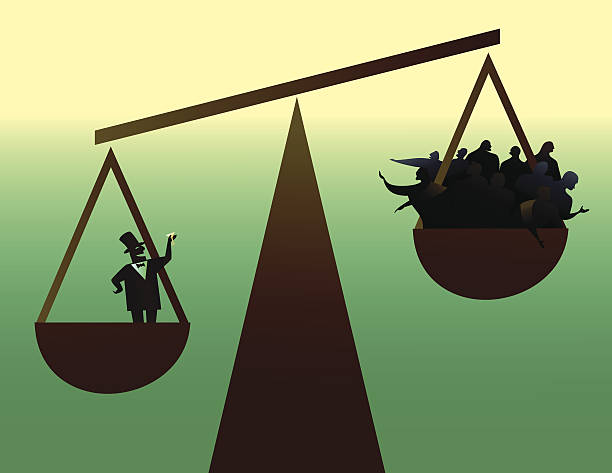
Much of my work as a proposal writer has centered around telling stories. It is about creating compelling stories so that funders come to invest in development projects, from research centers to bursary programmes, initiatives to combat the effects of climate change, soup kitchens, facilities for people with disabilities, land restitution projects, skills development and employment projects. In all of this I often wondered if I could work myself out of a job. Would it be possible to create situations where funding proposals and grants are no longer needed, where research and students are fully funded, communities are resilient to climate change, the hungry can always be fed, disability is no longer an obstacle, land is equitably distributed, youth have skills and opportunities to participate fully in the economy. The more I thought about this, the more elusive I began to feel and the more I realized that we will always have a need for proposal writers and development offices, as long as inequality and injustice persist. I became convinced that the work of development aid, philanthropic grants, donor funding, are not just encapsulated within the moral obligation of the act of giving but rather a matter of social justice: of restoring and preserving human dignity. The more that I looked at my work from this perspective, the more disturbed and uneasy I became, because I realized how the work of humanitarianism can also run the risk of being misplaced in a world at odds with itself, how the power contained within aid can also act to stifle the same human dignity that it seeks to liberate.
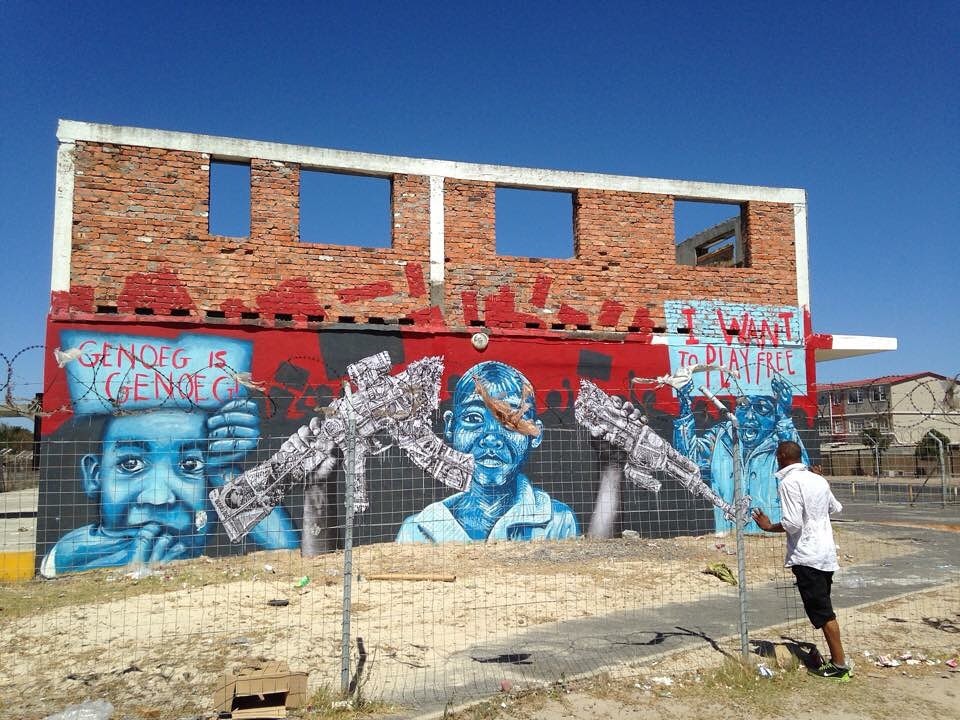
A mural by Ralph Ziman in Manenberg, South Africa. It reads, in Afrikaans, “Genoeg is genoeg” (Enough is enough) and “I want to play free”
In this reflection I would like to share some of my disturbing thoughts and uneasiness, in the hope that you may join me in being somewhat iconoclastic about misplaced notions of humanitarianism. I will begin by outlining my perspective or frame of reference, formed by my personal background, work experience and reading within this field, then applying this perspective on situations that give examples of misplaced humanitarianism, before going on to reflect on how a redistribution of power may help to address marginalization, most especially as we face the terrors of conflicts, climate change, and ultraconservatism.
Perspective on Humanitarianism
I grew up in the community of Chatsworth in the South of Durban in South Africa, a neighbourhood that was constituted as one of the ghettos of apartheid’s forced removals programme. It was a tough place to live, cut off and isolated from the leafy suburbs that we saw heralded in newspapers and magazines as the legitimate pathways to success. Inasmuch as the trauma of this social isolation manifested in social ills such as poverty, unemployment, alcohol and drug abuse, violence, and gangsterism, it was also a place where we celebrated birthdays, went to school, climbed trees, played games like Gooli Ganda and Hopscotch on the road, where people got married and raised families, and most importantly where we could also go to a neighbour and ask for something we didn’t have and no matter how little your neighbour had for themself, you would never walk away empty-handed. The idea of giving was very much embedded in the survival mechanism of a ghetto community, that we are in this together and all we have is each other. So, our notion of dignity came from the sense of reliance we had on each other. Much later on in life I stumbled on a quote from John Mbiti which resonated well with my experience of finding dignity: “I am because we are and since we are, therefore I am.” (Mbiti, 1969: 106)
My experience of working in development offices has brought me to a closer understanding of some of the origins of humanitarianism and what almost every state in the world has committed to, as outlined in the Geneva Conventions. As John Pringle and Matthew Hunt (2015: 1) point out, formal notions of humanitarianism originated in the context of war and arose very much from what has come to be known as the Duantist tradition, from the work of the Red Cross, pertaining to the “action of saving lives, alleviating suffering, and restoring and promoting human dignity among adversity and animosity. This understanding has broadened to include “natural disasters, famines, disease outbreaks, population displacement, and systemic social injustices relating to poverty, inequality, and neglect. Such problems of human suffering, or crises of humanity, overwhelm local capacities and thereby demand assistance.”
Writers such as Thomas Pogge (2008: 3) have helped to shift this conversation further by equating humanitarianism with the struggle for human rights and social justice. He makes the point that we largely concede that the affluent should do more to help the poor but this is seen as a demand of charity and not as a demand for justice. He says: “the existing radical inequality is deeply tainted by how it accumulated through one historical process that was deeply pervaded by enslavement, colonialism, even genocide. The rich are quick to point out that they cannot inherit their ancestor’s sins. Indeed. But how can they then be entitled to the fruits of these sins: to their huge inherited advantage in power and wealth over the rest of the world? If they are not so entitled, then they are, by actively excluding the global poor from their lands and possessions, contributing to their deprivations.”
As one who has grown up under circumstances of deprivation and isolation, I concur. I agree that this framing of humanitarianism, as a conduit of social justice and dignity, reveals the discordance of efforts that set out to provide assistance while replicating the circumstances that created this need for help.
Replicating Inequality and Commodifying Suffering
Dambisa Moyo (2009: X), in one of her many widely acclaimed works, Dead Aid, presents a riveting account of how the intentions behind development aid have been thwarted by geopolitical rivalries and self-serving interests and brought about socio-economic regression rather than progress, particularly in Africa. This is evidenced in the stark reminder that between 1970 and 1998, when aid flows to Africa were at their peak, the poverty rate in Africa actually rose from 11% to a staggering 66%. This was largely because aid was concentrating on creating client regimes of political and economic benefits to donor countries, thereby strengthening aid dependency and keeping beneficiary countries in a perpetual child-like state.
Moyo’s (2009: 44) famous mosquito net scenario is an apt anecdotal expression of how this happens: “A mosquito net maker in Africa manufactures around 500 nets a week, employing 10 people who, in turn, support up to 15 relatives. However hard they work, though, they cannot make enough nets to combat the malaria-carrying mosquito. Along comes an international movie star who rallies Western governments to collect and send 100,000 nets at a cost of a million dollars. The nets arrive and the good deed is done. With the market now flooded with foreign nets, our local mosquito net maker is out of business, with his ten staff jobless and unable to support 150 dependents.” The aid-dependency model has eroded whatever fragile chance for sustainable development that existed, whereas the goal of aid should be on creating good public institutions that ensure long-term benefits.
Going back to our perspective of humanitarianism as “serving the interests of beneficiaries, rather than political, religious, or other agendas, avoiding manipulation by economic or geopolitical strategic interests,” (Pringle & Hunt 2015: 2) Moyo demonstrates how aid has in the past served the interests of donors and neglected the opportunity to empower local structures towards self-sufficiency.
Another more visual example of humanitarianism neglecting the cause that it intended to champion, is one that many of us probably encountered as our first experience of humanitarian fundraising appeals. Many writers, for example Dennis Kennedy (2009: 2), have raised the issue of the ethics of representation, how funding agencies have tended to exploit images of human suffering. Much of the imaging of the Global South is in fact framed around images of the anonymous hungry child or homeless refugee and these images are therefore contradictory in effect since it raises social consciousness but it also discards that which is most human about the beneficiary, that is their autonomy, their identity, their agency, their dignity. As Costas Douzinas (2007: 19) explains: “undifferentiated pain and suffering has become the universal currency of the South and pity has become the global response of the North.”
A number of studies have probed this notion of the commodification of suffering, through the use of images by funding agencies to illicit emotional responses that result in increased donations for a particular cause. The People in the Pictures report by Save the Children (Warrington & Crombie 2017) and the RADI-AID Research project (Girling 2019), for instance, have fielded public opinion about the use of negative imagery in fundraising and found challenging recommendations for AID agencies to tell more authentic stories about the individuals featured in their communication, to give greater context about community members, about local development workers, about successful endeavours undertaken by beneficiaries, such that they are represented with identity, dignity, and agency. Denis Kennedy (2009: 23) argues that we can bring about this shift in consciousness from the public as external spectators, to a civic, engaged humanitarian public and in this way agencies would be able to stop commodifying suffering and rather “mobilize compassion for deeper and more fundamental engagements.”
Power and Empowerment
The representation of identity, dignity, and agency reminds us of a huge elephant in the room when we talk about aid and that elephant goes by the name of power. Power is at play from the moment an NGO writes a letter of enquiry, sends a concept note, or develops a proposal for a funding agency. Fatima Asif et al (2020: 3) point out that power imbalances lie at the heart of philanthropy since funders hold the money, or power, over beneficiaries but there are also different ways of wielding power and while much of this presentation has pointed out the blindspots of aid in its various forms, let us spend a moment considering the ways in which aid works to fulfil its intention of raising agency and restoring dignity.
Indeed, funding agencies, government development departments, philanthropic organizations wield an incredible amount of power. They have the power to take risks, to innovate, to advocate, and exercise independence (Asif et al 2020: 4). The rebalancing of power within the context of inequality and social injustices, which give rise to the need for aid, involves capacitating individuals and communities. Going back to Moyo’s mosquito net illustration, therefore, the power that was directed externally could have been invested in building structures that capacitate local communities to exercise their agency and achieve self-sustainability. This is where grants that provide capital, provide training and expertise, with a comprehensive outlook on long-term goals, rather than just short-term efficacious intervention, makes for deeper engagement and lasting impact.
Certainly, a funding agency cannot provide funding to a single organization to do everything but they hold the power of influence and to garner added support for the organizations that they fund. More and more philanthropic organisations are going beyond providing only financial support but also using their power of influence to network with other funding agencies to provide supplementary support for organizations through staff secondments, directly sourcing service-providers, making use of their own in-house services and expertise for projects undertaken by beneficiaries of their grants. Many philanthropic organizations are also realizing their responsibility to advocate on a national and regional level through mobilizing for policy and finance commitments from governments around the causes they support, and in that way helping to build structural frameworks on which NGOs can attach their efforts and continue to hold governments accountable.
Equally important is the role that beneficiaries play among funding agencies and philanthropic foundations, in the sense that they are not merely confined to receiving grants according to prescribed expectations and agendas, but rather that they participate in the discussions around these agendas and are intricately involved in setting expectations. It is encouraging to see how many Boards of philanthropic foundations have made a place at the table for beneficiaries to provide the insights into pathways that need to be forged for greater impact. In this way, foundations build stronger relationships with NGOs and enable them to determine for themselves where the funding is most needed rather than spending endless hours filling out prescribed funding templates and onerous reports that take precious time and expertise away from the actual work that changemakers need to get on with. This also involves foundations sharing resources and expertise with monitoring and evaluation, in a way that is customized to the unique culture that NGOs practice and more closely aligned with their own voice. In a similar light, we find that donors are relinquishing the power of representation and passing on the communication tools to beneficiaries to capture aspects of their lives which they value the most and to write their stories in ways that they would like the world to understand. It is indeed a liberating sense of enabling personal agency and in this way humanitarianism takes on a decolonial identity inasmuch as it advocates for the reclamation of agency and the restoration of dignity. There is a reciprocal energy here, as Fatima Asif et al (2020: 15)remind us, because “NGO’s cannot achieve their mission without funding and funders cannot achieve their mission without the work of NGOs”. And so in this rebalancing of power we do in fact realize that we are in this together, and all we have is each other.
Inasmuch as humanitarianism has sometimes struggled in the balance of power, aid, and dignity, there are far more ways in which it can triumph and ways in which we can make good on our intentions to right the wrongs that have created the need for aid. The crisis that we have been thrown into, through the atrocities of numerous national and regional conflicts, of climate change disasters, of movements that push back against inclusive and progressive policies, all of this is very much akin to circumstances of a ghetto in terms of the isolation and dislocation we experience. Even though this is a dark place right now, it is also an opportunity to refine our intentions. Arundhati Roy (2020: 214) wrote about the COVID-19 pandemic as a portal for distillation and reclamation, which is still very appropriate for the circumstances we experience at this time. She says “we can choose to walk through it, dragging the carcasses of our prejudice and hatred, our avarice, our data banks and dead ideas, our dead rivers and smoky skies behind us (we can choose to walk through it dragging all this behind us), or we can walk through lightly, with little luggage, ready to imagine another world and ready to fight for it.” So here we are in a time of conflict and change, distilling and refining our ideas. Let us acknowledge the uneasiness, the disturbance, the discomfort, and the uncertainty because it enables us to be self-critical and accountable and to take responsibility for each other’s sense of dignity.
By Merlin Ince
____________________________________
References:
Mbiti J S (1969) African Religions and Philosophy. Oxford: Heinemann.
Pringle J & Hunt M (2015) ‘Humanitarian action’ in ten Have, H (ed) Encyclopedia of Global Bioethics. Heidelberg: Springer.
Pogge T W (2008) World poverty and human rights: Cosmopolitan responsibilities and reforms. Cambridge: Polity Press.
Moyo D (2009) Dead aid: Why aid is not working and how there is another way for Africa. London: Penguin Books.
Kennedy D (2009) ‘Selling the distant other: Humanitarianism and imagery – ethical dilemmas of humanitarian action’. The Journal of Humanitarian Assistance 28: 1-25.
Douzinas C (2007) ‘The many faces of humanitarianism’. Parrhesia Journal 2: 1-28.
Warrington S & Crombie J (2017) The people in the pictures: vital perspectives on Save the Children’s image making. London: Save the Children.
Girling D (2019) Radiaid research: A study of visual communication in six African countries. Radi-Aid: Oslo.
Asif F et al (2020) A rebalancing act: How funders can address power dynamics. NPC: London.
Roy A (2020) Azadi: Freedom, fascism, fiction. London: Penguin Books.


 Marginal Identity