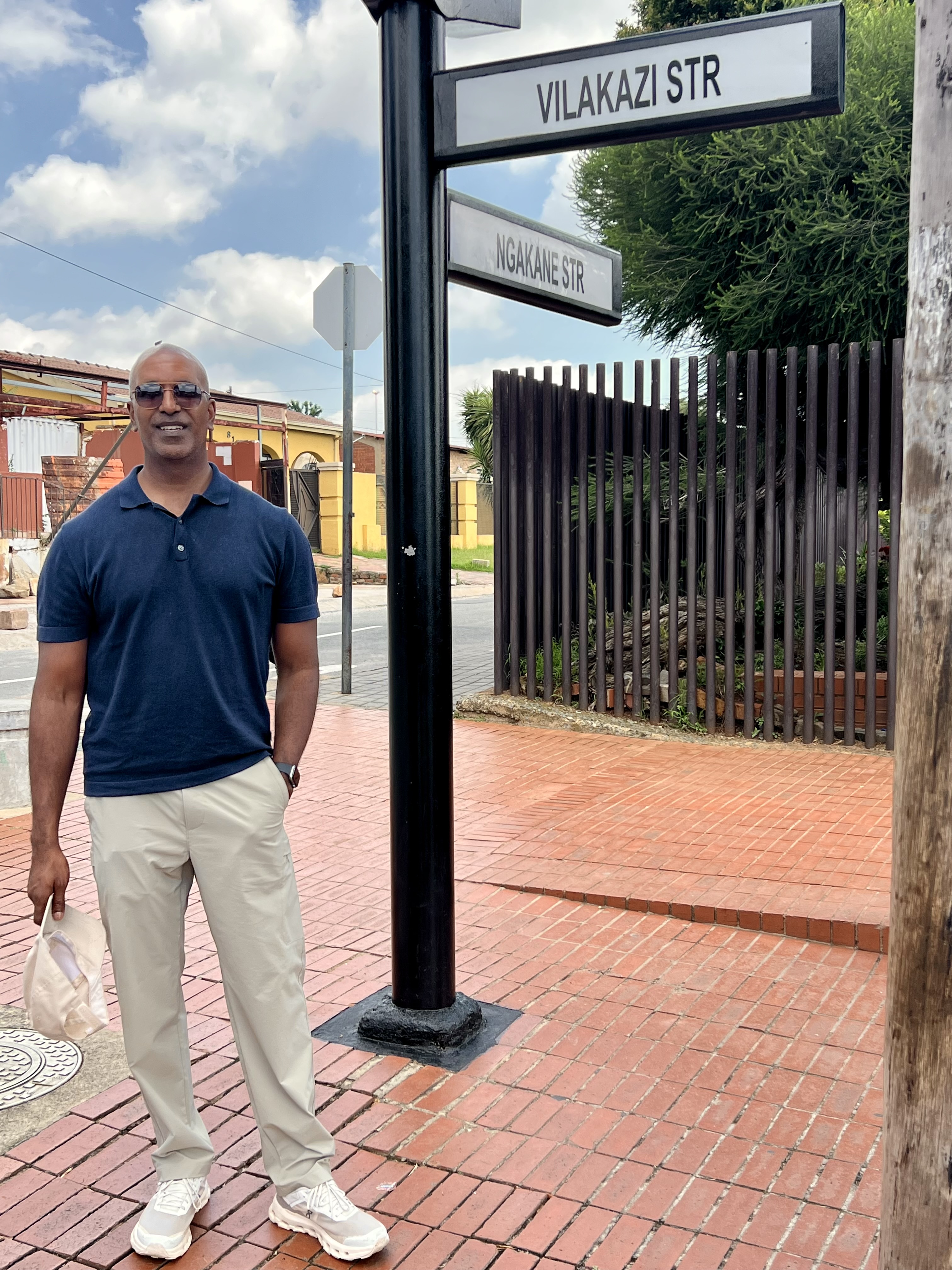
I went to Vilakazi Street precinct to see the Hector Pieterson Memorial, carrying with me a quiet reverence that had been forming for years. June 16, 1976 has always lived in my imagination as a moment of terrible courage, of adolescents whose lives were interrupted so completely that resistance became the only means of growing up. More than just being a tourist, I wanted to stand before the memorial as a witness, as one paying attention to a sacrifice that still asks accountability of the present.
But I never reached it.
It was early in the morning, before the shops and restaurants opened, and before other visitors arrived. Vilakazi Street precinct, usually animated and reassuring in its busyness, felt temporarily unguarded. Its openness was exposed rather than welcoming. A group of young men approached my partner and me. They greeted and performed a piece of rap that they composed. They were playful at first, then started to ask for money. When we explained that we didn’t carry any cash, they did not move. They stayed close. They followed as we walked.
What unsettled me was not the request itself, but the refusal of distance. The interaction did not resolve. It lingered. The street was quiet enough that there was no social buffer, no witnesses, no easy way to disappear into a crowd. My body registered the change before my thoughts did. There was a tightening, a calculation, a sense that the situation could tip suddenly and without warning. We turned back toward the main precinct, choosing safety over intention, aware that we were retreating from the encounter with memory we had sought.
This was not paranoia, nor moral judgment. It was a plain, physical awareness of vulnerability, of being outnumbered, of being watched, of not being able to predict what would happen next.
The memorial remained unseen, just beyond reach.
What stayed with me afterward was the contrast it exposed. The youth of 1976 appear in our national memory as brave, morally luminous figures. They were children who gave up their childhoods to confront an unjust system. The group of young men we encountered that morning elicited no such admiration. They stirred fear, even resentment. Where I expected reverence, I felt vulnerability. Where I sought moral clarity, I encountered discomfort.
This contrast is tempting to simplify, but it resists easy judgment.
Memory often works by distance. We remember the past by smoothing its edges, by transforming chaos into meaning. The youth of June 16 have been folded into a narrative of sacrifice and heroism that allows us to honor them without confronting the full terror of their circumstances. Memory grants them dignity but it also freezes them. They remain forever courageous, forever legible, forever deserving.
Fear works differently. It is immediate, bodily, untheorized. When fear enters, moral reflection narrows. The youth who approached us were not symbols. They were unpredictable presences. I could not hold them gently in thought because I was busy calculating escape routes. Fear does not ask who someone is within history. It asks what they might do in the next ten seconds.
This is where moral distance emerges.
The youth of 1976 feel close to us emotionally because they are safely far away in time. The youth of today feel distant because they are uncomfortably near. One group reached us by memorials, photographs, and stories, while the other confronts us by instinct, risk, and self-preservation. One invites empathy without cost, while the other demands it under pressure.
And yet, the space they occupy is the same.
Vilakazi Street precinct holds memory and aftermath side by side. The memorial asks us to pause, to reflect, to honour a struggle that promised a different future. The living street insists that the future arrived unevenly. Liberation ended a system, but it did not complete a moral project. The young men we encountered do not negate June 16 inasmuch as they are part of a struggle that is still unresolved.
What unsettles me most is how that unresolved struggle made itself felt there, in a place meant to anchor courage. Turning back felt like a small personal failure, but also like a revelation. I could not reach the memorial because the conditions it stands against have not been fully dismantled. The path to remembrance was blocked not by malice, but by neglect, inequality, and the long shadow of unkept promises.
Perhaps that is the harder truth that the Vilakazi Street precinct told me.
The memorial commemorates adolescents who were forced to grow up too soon. The youth I met are growing up in a society that does not know what to do with them. One group is remembered because they died in the clear violence of apartheid, while the other survives within quieter, less visible structures of economic and social injustice, in ways that unsettle us. The distance between them is structural rather than moral.
I did not get to stand before the memorial. Instead, I stood inside the contradiction it represents. And maybe that, too, is a form of witnessing. Perhaps there is also a need to acknowledge reverence interrupted by fear, admiration strained by reality, and to leave knowing that remembrance without responsibility is incomplete. The Vilakazi Street precinct did not fail me. It refused to let memory stand alone.
Written by Merlin Ince
 Marginal Identity