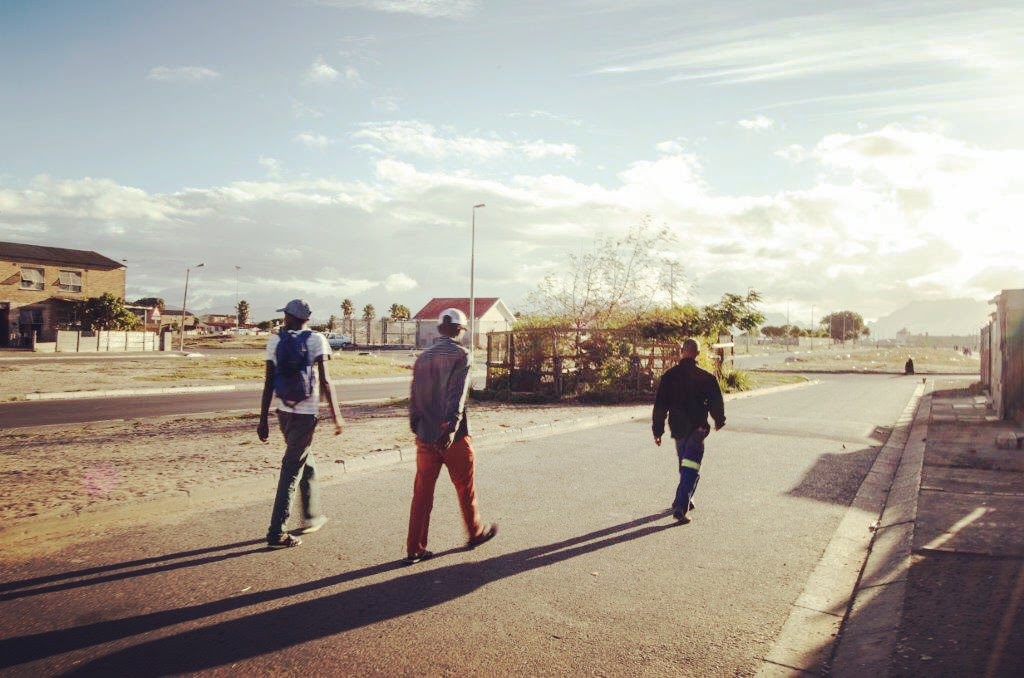
On a quiet and chilly July afternoon I headed out to Manenberg for a research interview. I was meeting with youth and their families, listening to stories about how they encounter social hardships in trying to find work. Manenberg is an underserved and marginalized neighbourhood on the outskirts of Cape Town. As a relic of the apartheid-engineered city, residents still bear the contempt and pain of being forcefully removed and resettled on these dusty windswept plains of the Cape Flats.
Manenberg’s bustling streets were virtually abandoned on this afternoon, either an ominous sign of a gang fight or a more tempered measure of taking cover from the cold especially since the first rains had fallen. I decided to follow the cue from the presence of fruit sellers who would not have set up shop in the event of any impending unrest. I take my chances, as people do everyday in Manenberg.
I walk out from one of the apartment blocks, and I am cautioned by the nervous gesture of a young man approaching me. We are on opposite sides for now, of the fence that cordons the territory of the block. He is outside and I am on the inside. He stops and takes a step back. His gaze is steady on me but I drop mine to counter his engagement. He persists. “Are you an American” he calls out, referring to one of Manenberg’s most notorious gangs called The Americans. I laugh nervously, realising the poignant intent of such a question in territory ruled by the rival Hard Livings gang. “No,” I respond feebly, “No I am not.” He continues towards me and we pass at the gate. He glances over his shoulder, “I thought you were an American coming to kill me.” And then with him now on the inside of the fence and I on the outside, he turns to triumphantly announce words that numb me, “I do the killing around here.”
People who straddle marginal identities, particularly gangsters, often display a certain contempt that disturbs us who are outsiders. We interpret it as a cold disregard for mainstream society values and this is what shocks, abhors and horrifies us. We do not live in their world. We live far removed from the brutal realities that have turned little boys playing soccer on the street into knife-and-gun-wielding criminals. And because we live so far away from this world, we do not understand.
This is not an attempt to condone heinous crimes. It is rather an endeavour to discern what breeds such contempt in the hearts and minds of young men who belong to gangs. Brazilian author Jorge Amado, in his most famous novel, Captains of the Sands, gives an evocative portrayal of a group of street children who operate as a gang, thieving out a living on the streets of Salvador de Bahia. Amado navigates this gritty story with a delicate hand, as a constant reminder that these are little children who have been orphaned and abandoned by the social structures that favour wealth and prestige. The empty warehouse in which they live is a metaphor of the loss they have suffered, of their families and of the comforts that every child deserves in order to know what it is like to belong. Instead they are savagely beaten and punished by police authorities and the staff of so-called reformatories. What they long for is the affirming touch and embrace of a mother’s hand, or the warmth of a nourishing meal and a bed to dream the dreams that keep hope alive: “All of them were looking for affection, anything out of that life.”
I don’t think that anyone ever chooses freely to live a life of killing, thieving, or hurting other people unless you are consumed by emptiness, when comfort and love seem like elusive luxuries that you are never entitled to. It becomes a hard and heartless life, as a young man in Manenberg explains about his marginal identity as a gangster. He speaks plainly, with determination and no need for apology, about what it means to defend one’s pride and dignity when you do not have much to hold on to: “Don’t come running and try to pull me, no. I will hit you. I will make you very sore, you see. You can make me also sore and I don’t care… You gonna stab me, you gonna shoot me, it gonna heal again but the feeling inside can’t heal, my brother, you see no-one can heal this what you feeling inside…”
The youth whose stories I listened to over a four-year research period have offered a unique insight into the complexities of having dreams, talent, and ambition, yet having to contend with circumstances beyond their control that go against their aspirations. Youth who experience anger, frustration, despondency, often express this through external behaviour that does not convey a holistic understanding of their day to day experiences. When such youth are given an opportunity to tell their stories, we create a space for them to be seen and understood in a new light such that their plight may receive appropriate responses that are geared towards strengthening their agency to defy and transform their circumstances.
Perhaps one of the most telling examples of how structures impact on the way in which youth navigate education and employment is related by one of the young people from my research journey. Jennifer was filling out an application form for a training college programme and was required to name where she was from: “I didn’t know what to fill in there. It asked what suburb or township I am from and I thought, well I don’t live in a township or a suburb. I live in a ghetto. It is rough here. Will they even understand that?” This question lies at the heart of my research enquiry, as an endeavour to help people understand what spaces such as Manenberg really mean for young people growing up there. In telling these stories, we need to look deeply through the actual lived experiences of those who daily tread through the infrastructural and cultural obstacles that characterise the excluded ghetto. It means taking off the pseudonyms and precarious nomenclatures that glaze over the basic truths we sometimes find uncomfortable to face up to.
It is uncomfortable to call Manenberg an excluded ghetto but unless we name these spaces for what they really are, and tell the stories of people who inhabit them, then real change is all the more elusive. As highlighted by renowned writer and human rights activist, James Baldwin, in his 1962 essay entitled As much truth as one can bear: “Not everything that is faced can be changed but nothing can be changed unless it is faced.” It is a stark reminder of the responsibility we hold to speak about the confined realities of those who straddle marginal identities, not as they ought to be but rather as they are, if we are truly ready to face the task at hand of rebuilding, reconfiguring, and reimagining what is currently unacceptable.
Written by Merlin Ince
 Marginal Identity