The recent minibus taxi strike and ensuing violence in Cape Town has been like ripping off the band-aid from a wound that has never healed. It is painful. Excruciating actually. We all witnessed the horrific scenes of commuters walking over 15 km on a dark winter’s evening to get home, some with children, even pregnant, those sleeping overnight on the benches of taxi ranks, vehicles being stoned and set alight even with people still inside. It is the same Cape Town that is often hailed as one of the most beautiful cities in the world, and yet the ugly schisms of apartheid’s brutal group areas act from 1950 are still festering. This is perhaps the most horrific of realities that have been uncovered over the past few days of mayhem in this sick city. It is a strike that is one of several severe blows to Cape Town since decades ago.
The band-aid was always just a cosmetic cover-up. On any given day, we never really see the thousands of people who wake up at 03:00 every morning to get a bus or minibus taxi, so that they can be on time for work in the city. We rarely see the draining evening rituals of cooking, cleaning, homework, childcare, even second jobs and part time studies until late at night, only to be up again in a few hours to get to work. We rarely see the daily insecurity of being robbed, mugged, accosted, bullied, assaulted, or violated in the scarcely policed spaces of transit hubs on the Cape flats, worlds apart from the economic centre of the city that is ironically policed and powered largely by the people who are barred from living there. Usually, this is is covered up by the minibus taxis making up the distance between the disparate worlds of the marginalized and the mainstream. But Thursday 3rd August 2023 was not any given day. It was the day that took away the band-aid of a volatile minibus industry that is made up of questionably roadworthy vehicles that are the only affordable option for the majority of workers in the city. And now that it has come off, what do we actually see? The ugly and unacceptable gaping wound of displacement.
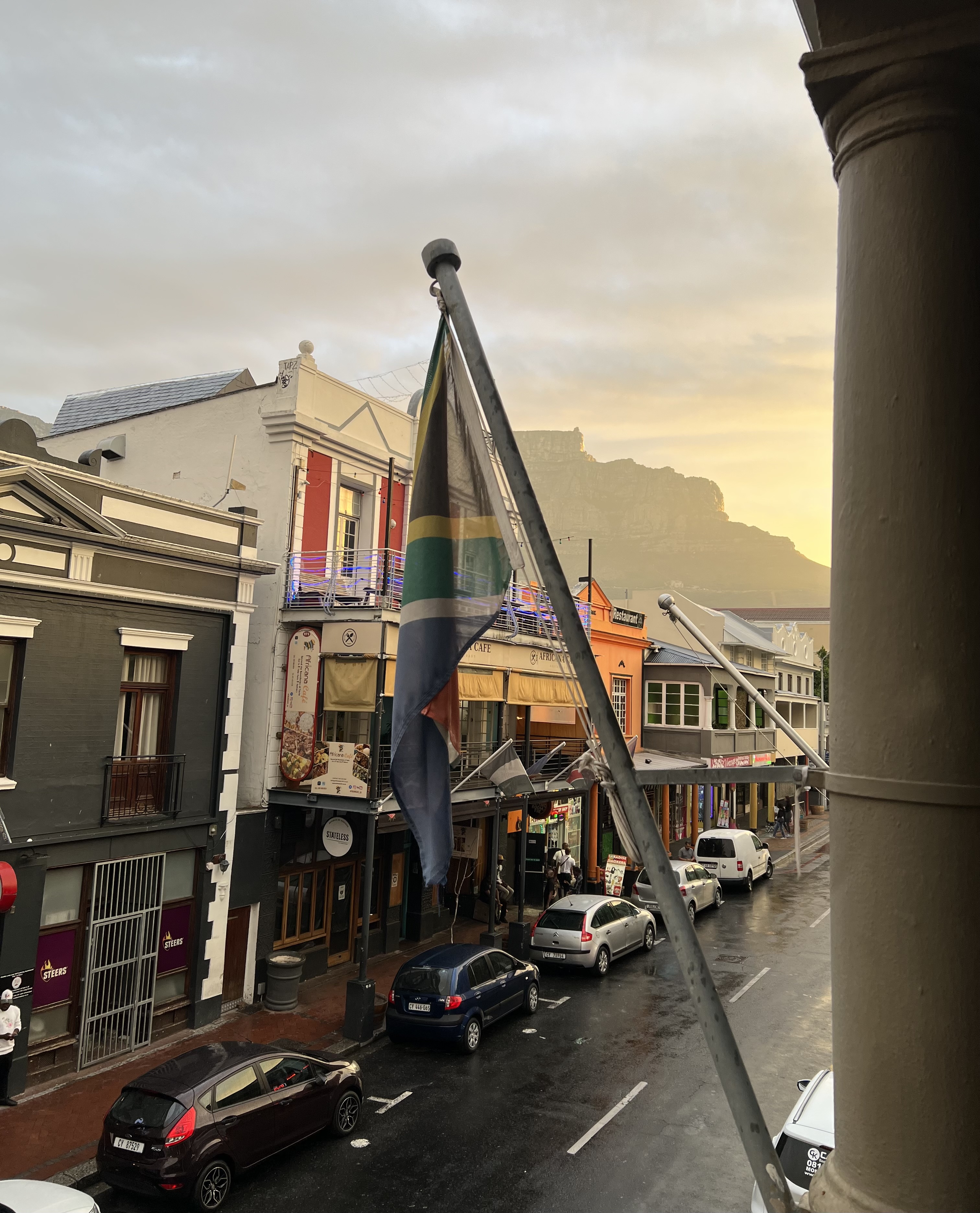
Cape Town has been unwell for a long time now. We have just ignored and neglected its ailing symptoms, in favour of building the aesthetic appeal that draws millions of visitors from across the world to enjoy its mountains and beaches, its winelands and gastronomic delights. How many of these visitors know the other side? How many have been to Manenberg, Nyanga, Gugulethu, Hanover Park? Wait. How many Cape Townians themselves even know Manenberg, Nyanga, Gugulethu, Hanover Park? Equally, how many residents of the Cape Flats have ever been up Table Mountain, or strolled the beaches of Camps Bay, or went shopping at the Waterfront? Very few either way. This is the sickness of Cape Town, that even after thirty years since the dismantling of apartheid legislation, the wounds have never healed but turned septic.
It is far from what we looked forward to in 1994, that the city centre and other significant economic hubs are still very much exclusive. Elaine Salo’s writings remind us that property markets and school fees in formerly Whites-only suburbs have soared and still exclude the meagre economies of the working class on the Cape Flats. This exclusion is further highlighted when tracing the greatest growth in employment opportunities as taking place in affluent suburbs that are not well served by public transport. Turok and Watson have found that the Cape Town Central Business District, together with the Northern and Southern suburbs, contains 37% of the population but still account for 80% of all jobs in the Cape metropolitan area. This pattern of car-oriented development has resulted in historically-disadvantaged neighbourhoods being further isolated from job prospects, along with the combined effects of lower income and the limited opportunities of moving to other neighbourhoods with higher quality schools and tertiary institutions.
Minibus taxis are by far the most common means of transport for residents on the Cape Flats. In Manenberg, for example, the difficulties of commuting to work are such that only between 05:30 and 06:30 is it possible to get a direct taxi from Manenberg Avenue into the city centre. From 06:30 to 08:00, when most workers commute, one can only get a taxi to Athlone and then wait for another taxi into the city centre. The number of people needing to commute daily, as compared with the number of taxis available is also disproportionate and the competition for a seat results in long queues. Most workers prefer rather to walk along Duinefontein Road to the Police Station, at a distance of 2km, where they can get a taxi either to the city centre and then connect to the Southern Suburbs hub of industries, or to Belville where they will then change to the particular area that they will need to access in the business hub of the Northern Suburbs. The journey to work each morning and back home in the afternoon is therefore each approximately two hours.
But let us stop here and ask ourselves what have we done since 1994? We have a minibus taxi industry as the most used transit system for marginalized neighbourhoods, some community halls, swimming pools and sports centres, even some parks and other recreational facilities. Some new public housing has gone up, still only in the Cape Flats, and a relatively minuscule number of families been able to return to District Six from where they were forcefully removed in the 1960’s. But has this been enough? Have these band-aids reduced inequality, redressed the injustice of discrimination, enabled spatial and economic mobility? Or have they shadowed and cosmetically covered up the real fractures of our society that have deepened into violent discontent? Surely we deserve, and can do, much better.
It is long overdue that the city centre and closely surrounding areas of Cape Town is re-engineered to create space for those who work in the city to live there too. It is long overdue that those families dispossessed of their properties in places like District Six and De Waterkant are granted preferential resident access again. It is long overdue that the many underutilized buildings in the city are repurposed as affordable and even subsidized housing for those who work and study in the city. These are the kinds of movements that will start to shift the imbalance of power and enable real transition towards an inclusive space that not only showcases cultural diversity through simulated performances to entertain the tourists, but actually lives and breathes the richness of our shared heritage.
There has to be an understanding that real change will always be uncomfortable. It will require us to sacrifice, give up, let go, all for the more lasting benefit of healing the divisions that bring about destructive discontent. There needs to be new milestones and targets set for evaluating how much progress we are making. We need to have transparent processes that tell us whether the employment patterns are shifting, whether the social, economic, and education patterns are moving towards greater equality. How many youth from marginalized neighbourhoods are completing school and accessing the formal economy? What proportion of low to middle income workers in the city are living there? How many residents still living in sub-standard housing schemes established under apartheid legislation are being enabled to inhabit housing that they no longer rent from the city but can take ownership of? How many workers are being capacitated to move beyond their current employment profile brackets from semi-skilled, to skilled, to management?
These kinds of people-centered indicators are targets that we need more of to authentically lay claim to such titles as one of the most beautiful cities in the world. Is this not a more convincing reason to want to be in Cape Town, to experience and be part of a community that is centered on human dignity, a city that is healed and wholesome, that has invested and taken care of those most in need? The cost of non-investment for essential and much neglected transformation initiatives is sure to be devastating. The apocalyptic scenes of the past few days in Cape Town are dire signs that we need to take heed of, that we are not a healthy city. We are in pain, we are still broken from a troubled history, but we also have the capacity to make reparation, to return what was taken away, to heal, and to be well again.
Written by Merlin Ince
Photograph by Merlin Ince
______________________________________________________________________________________________
REFERENCES
Salo E (2003) ‘Negotiating gender and personhood in the new South Africa: Adolescent women and gangsters in Manenberg township on the Cape Flats’. Cultural Studies 6(3): 345-365.
Turok I & Watson V (2001) ‘Divergent development in South African cities: Strategic challenges facing Cape Town’. Urban Forum 12: 119-138.
 Marginal Identity