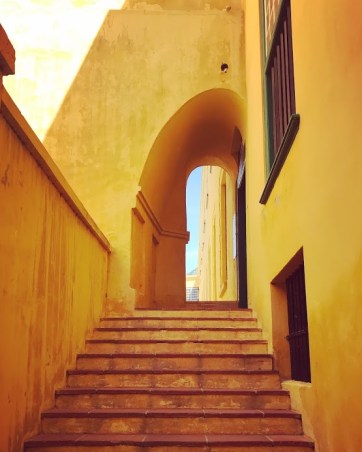
The stairway of a prison fortress reflects the idea of transcending confinement
Our National Freedom Day, on Monday 27th April in South Africa, seems like an ironic occurrence. While we grapple with the confines of a lockdown, the thought of freedom seems quite elusive especially because there is so much uncertainty about the future that we will step out into when restrictions are lifted.
Prior to April 1994, when South Africans of all races could vote together for the first time, we lived under hostile conditions of restriction and confinement. It was no surprise to often encounter measures that enshrined priviledged access only, as expressed through loud signs that declared: “Non-Whites and Dogs Not Allowed”. So, when the much-anticipated day of free elections finally arrived, it was with a sense of magical realism that scenes of a unified nation unfolded. It felt quite strange to believe that we were part of a fantastical dream coming to life: people of all races and languages and creeds standing in the same line to vote, some even with their dogs right beside them.
26 years since that historic moment, we now find ourselves at another watershed experience. Today we reflect on our freedom in the context of a global pandemic that has restricted so much of our free movement and access, denying us the priviledges and securities we have come to take for granted.
Even the healthiest among us are succumbing to COVID-19, previously powerful economic structures are crumbling, the communal interactions that build our social morale have ceased, while uncertainty over our personal and societal wellbeing often leaves us fearful, anxious, and gasping for hope. What is then the quality of our freedom?
Perhaps we can look to our past for values that enlighten our struggle with adversity and confinement. Freedom Day this year is an opportunity to reflect more deeply on the transcendence of the human spirit, beyond physical confines. It is a lesson that we have all learnt through the examples of our struggle heroes who fought for our emancipation even though they faced incarceration.
While their confinement was imposed by the unkindness of human actions and their circumstances were unimaginably more severe than the lockdown measures of a pandemic, we can draw courage from their determined transcendence.
Many scholars and writers have commented on the way in which leaders such as Nelson Mandela, Ahmed Kathrada, Govan Mbeki and others strengthened their ideas of liberation while in prison on Robben Island. Crain Soudien, for instance, argues that prison gave them a concentrated opportunity to think through the contradictions of South Africa, to refine their strategy and beliefs about the kind of freedom they wanted to pursue: “the experience of imprisonment on Robben Island, its harshness and, principally, the taking of control of its intellectual temper by the prisoners themselves, all contributed to a rich range of alternative imaginings of South Africa.” Martha Evans goes to the extent of observing that Mandela’s imprisonment on the mysterious island turned him into a virtual mythological hero.
What we need to clarify, though, is that prison was not some form of necessary evil for freedom. Prison gave them nothing. They suffered abuse, torture, and abandonment, while being subjected to dehumanizing treatment that sought to break their spirits. The transformation that they brought about was of their own doing, an enactment of their own leadership.
The experience of abuse and torture was likewise experienced by struggle leaders who did not go to prison but endured house arrests and banning orders. Lilian Ngoyi and Helen Joseph were among the leaders of the 1956 defiance march to Pretoria, in protest against the pass laws that denied people freedom of movement in their own country.
Even within these confines and despite constant police interrogation, they rallied for international support of the anti-apartheid campaign, promoted the efforts of activists working underground, strengthened the defiance movement, and conscientized a nation towards emancipation.
Our South African liberation leaders could have chosen to plot revenge and we might argue that they could have given in to bitterness, anger, or the need for retribution, but they did not. They chose otherwise. As Ahmed Kathrada is quoted repeating in various interviews: “Bitterness only affects the person carrying it”, or as Nelson Mandela himself declares: “If I allowed myself to become bitter, I would have died in that prison.” They chose life, vitality, and transcendence. They studied, read, and wrote prolifically. They engaged in seminars, debates, and philosophical discourse. They exercised their bodies and minds, such that they lived beyond their material confines and they enabled their spirits to soar.
The notion of transcendence is perhaps most eloquently described by mystics such as St John of the Cross. Written in the 16th century, his highly acclaimed poem “Dark Night of the Soul”, traces the spiritual journey of overcoming affliction and adversity as we aspire towards a higher sense of consciousness that confers liberation from material and human confines. In order to do so we must endure the night of the senses: our anger, fear, loneliness, hurt, abandonment, so that we can transform natural understandings of and responses to these afflictions into higher wisdom. It is only if we understand the Dark Night of the Soul for what it is and for the destruction it threatens to bring, that we can conquer it, transcend, and awaken to a new birth.
Mandela, Ngoyi, Suzman, Kathrada, Mbeki, and countless other freedom fighters came to know darkness. They too were afraid as they had to encounter and battle their own personal demons but they also found new ways of breaking through this fragility. They displayed dignity and restraint, and countered physical violence with intellectual prowess, thereby transcending the unknown of victimhood and charting a path of emancipation not only for the oppressed but also for the oppressor.
The unknown and uncertainty that we currently struggle with can also be an opportunity towards re-birth. We could merely resist the adversity that threatens our vitality, or we could start to reconfigure ourselves and transcend the confinement that this pandemic has imposed upon us.
We can re-imagine the way in which we build physical immunity through revised eating plans and lean food consumption. We can use the experience of uncertainty to train our minds in finding greater clarity by being more present in the now, rather than trying to relive the past or overthink the future. We can allow the quarantine practice of living with essentials to temper our tendency towards excess accumulation of material possessions.
As the COVID-19 pandemic reveals more socio-economic gaps and rifts in our society, we can start to practice greater social empathy and engage in campaigns that challenge inequality. We can give greater support for small businesses and entrepreneurial enterprises, rather than just mainstream business, so that the informal sector can grow and contribute towards a more robust economy.
We can use this quiet time to learn a new language, take up a new hobby, start a new exercise routine, discover something new and refreshing about ourselves.
Like the heroic stalwarts of our political freedom, we too can exercise our agency towards new ways of thinking and living beyond the constraints of our physical confinement. We too can be great in the face of adversity.
Written by Merlin Ince
 Marginal Identity