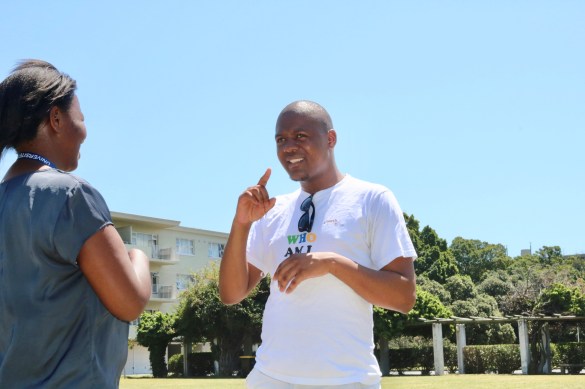
Qobo Ningiza with sign language interpreter Tshepiso Mokoena
Some of the most courageous stories we encounter are from those who navigate worlds that are structured to exclude them. The marginal identity of people with disabilities is one that we often recognise but we seldom understand what it takes to brave the relentless obstacles that such individuals face everyday.
Among them is Qobo Ningiza who will soon be the first deaf law graduate in South Africa. Not only did he have to overcome the challenges of a school experience with poor education resources and limited opportunities for tertiary study, it was also a matter of navigating a study path that relies heavily on verbal presentations and interactions. Motivated by a desire to seek equality, Ningiza resolutely chose to face the odds. His example is in itself a victory for social justice as he is now about to qualify with a Bachelor of Laws (LLB) degree and hopes to pursue a career in Human Rights Law.
Born and raised in Ntseshe location, Ngqamakhwe District in the Eastern Cape, Ningiza is the fifth born out of six children and the only deaf person in his family. He describes his schooling experience as one with severe disadvantage since the limited resources at schools for the deaf meant that learners had to share textbooks and cope with poor infrastructure. Due to a shortage of teachers they could also not choose subjects but had to comply with a prescribed list. As compared to the school experiences of his siblings, Ningiza grew in consciousness of these shortcomings in the implementation of human rights and became determined to change this.
His attempts to pursue tertiary studies in law were so challenging that he spent an entire year trying to gain entrance at a university that would accommodate deaf law students. He recalls travelling with public transport over a long distance to an institution for registration. He found another aspiring student making the same journey, at that time a stranger but now a close friend. Since they arrived after the offices had closed, they spent the night sleeping next to a lamp post in the parking lot. When Ningiza finally got an interview he was told, within the first five minutes, that the institution would not be able to provide sign language interpreters and he was denied access again.
Ningiza’s experience at the University of Cape Town was such that the Disability Service facilitated his registration for tuition and residence. The Service also assisted him in accessing comprehensive bursaries such that any financial challenges were overcome. Ningiza received dedicated support with sign language interpretation and also had assistance from fellow students with taking notes in class since it is impossible to take notes for oneself and focus on an interpreter simultaneously. Much of the funding for UCT’s Disability Service and student bursaries is thanks to the support received from donors.
Ningiza is currently working on applications to law firms in order to serve his articles next year but this is another challenge since firms have thus far been hesitant to accept him given that they do not have facilities for deaf candidates. Ningiza is however hopeful that an opportunity will soon emerge and that his career may reach fruition: “there is nothing I want more than to make a difference in other people’s lives. I believe that we are a country with a lot of potential and that many of our problems would disappear if we focused our energy on assisting those in need.”
 Marginal Identity