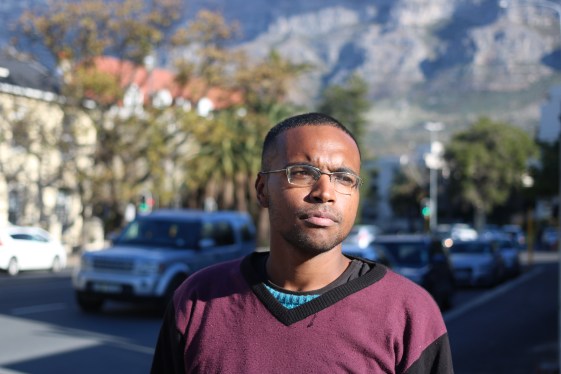
Ameer makes a living from collecting cardboard and metal cans for recycling
It is very easy to ignore a homeless person. The idea of not having a secure place to live or a weathered appearance conveys a sense of anonymity. Their identity becomes opaque and distant from the mainstream traffic of cities, hastily rushing to work or back home. For those who have neither of these, they struggle to find recognition. Living on the streets is a marginal existence but there are still stories of dignity behind every face of such hardship.
The City of Cape Town’s mayoral committee for social development has found that there are more than 7 000 homeless people in the municipality. Ameer is one such person. He came to Cape Town from Bloemfontein on a pretentious job offer, expecting to work as a van assistant on overnight truck hauls, with the promise of advancing his interest in motor mechanics. Instead, he was told to guard trucks owned by a businessman who was not prepared to pay the expensive fees of truck stations. Ameer was not remunerated, he was mistreated, and left to fend for himself. With no family or other support network in Cape Town, he took to the hostile streets of the city to make a living.
On any given morning, Ameer can be found outside the Woolworths on Kloof Street where he has an arrangement with the store manager to collect the cardboard from delivery trucks. He also collects empty metal cans which he crushes into flat disks, all for recycling. It is a harrowing mission to transport these waste materials on a makeshift cart about 3km from the CBD to Woodstock, competing with the morning traffic that impatiently hoots at him for getting in their way. This same traffic hurries off to produce more waste that Ameer finds a purpose for. He sells the cardboard for about 70c per kg and the cans for R10 per kg. He makes just about enough to buy some food for the day.
The Centre for Food Security at the University of the Western Cape has found that individuals like Ameer, across the country, save municipalities R 700 000 per year by keeping recyclable material from exhausting landfill sites. But despite the dignity and purpose that Ameer manages to find from wastepicking, he still faces indignation.
Security personnel in the city consider Ameer as a criminal. He is often rudely awakened from the meagre shelter of an alleyway or bus stop by a group of security guards. They have used pepper spray and batons on occasion to wake him up and chase him away: “They think I am going to break into the cars and steal something,” he says. “I just avoid them. I can’t even sit anywhere I want. They watch me like I am going to steal something. That is what I wish for more than anything else, just to be able to walk and sit anywhere. But that creates trouble for me so I just avoid them.”
Thankfully Ameer has been able to experience a kinder face of the city through a clinic in Greenpoint. Even though he is not an outpatient, the facility still provides support for him. Ameer is able to speak with a counsellor, take a shower, and have a meal twice a week. His face lights up and softens when he speaks about the care he receives, like it is an oasis of hope in the midst of a harshly marginal existence out on the streets of Cape Town.
Hope is what Ameer holds on to most firmly, resolving himself not to give in to the tragedy of what brought him to this space: “I do my best everyday with whatever I can get. I still want to go back home to my grandmother in Bloemfontein.” Ameer has been trying to save money to afford transport back home to be reunited with his grandmother, younger brother, and sister. He also has dreams of pursuing a career when he has settled himself again: “I always wanted to work with cars, like a motor mechanic, even to one day own my own workshop, I would be so happy for that.”
Holding hope and adversity is hard to do. Those who live on the margins must bear the strain of this arduous identity everyday, tragically muted by the traffic of mainstream city life, chasing capital. This counterpoint of city life is highlighted by artists such as Brazilian writer Jorge Amado. In the introduction to his novel Captains of the Sands, Colm Tóibín points out that Amado unearths the dignity of abandoned children on the streets of Bahia in Salvador but the book does not romanticize their story, “it is written to give substance to shadows, to re-create the under-life of the city, to offer the dispossessed an inner life.”
Stories of people like Ameer can help us bring light into peripheral shadows in order for us to re-create cities as more inclusive and respectful spaces. But only if we slow the traffic down, stop, and listen.
 Marginal Identity
There are thousands of homeless from all races and religions. One can only but wonder where the love of the faith communities are placed.
LikeLike